MBTI vs DISC: Which Team Workshop Is Right for Your Team?
Your team workshop is booked, but the assessment is not chosen. MBTI and DISC both promise better communication, and picking the wrong one wastes a session your team could spend on real friction.
This article compares MBTI and DISC for team workshops, explains what each measures, and shows how OptimizeTeamwork runs both formats. By the end, you will know which assessment fits your team's goals and how to decide with confidence.
What Is OptimizeTeamwork?
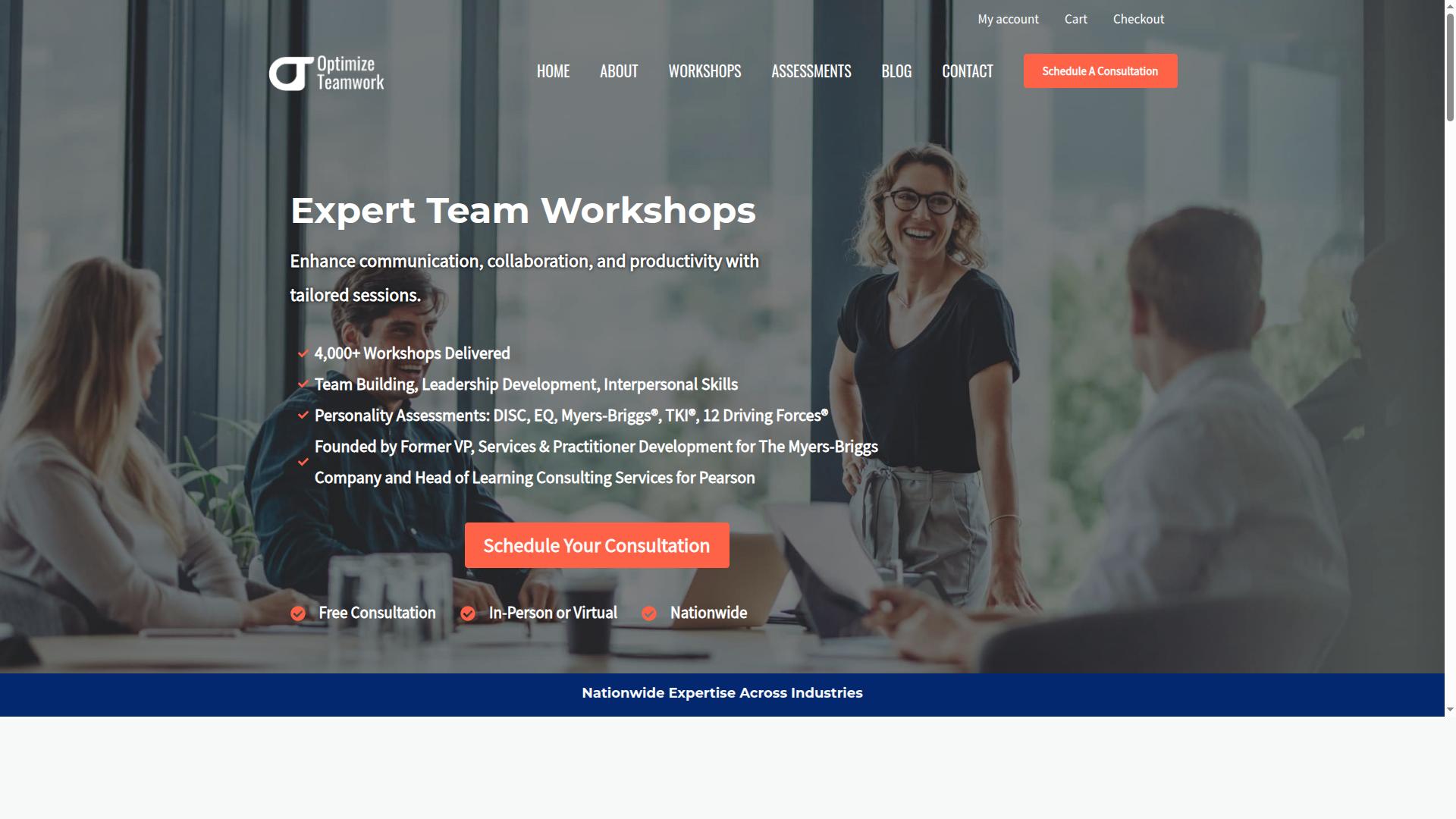
OptimizeTeamwork is a professional development and team training consultancy that specializes in expert-led workshops designed to enhance communication, collaboration, and leadership effectiveness. The firm was founded by Dr. Rachel Cubas-Wilkinson and positions itself as a practical partner for organizations that want to improve how teams work together.
Workshops are available in person and virtually nationwide, which makes the consultancy accessible to distributed teams as well as on-site groups. Sessions can be delivered with or without a personality assessment, so a team can choose a full assessment-informed experience or a lighter facilitation-led format.
The track record is substantial: more than 4,000 workshops delivered and 30,000+ leaders trained. Offerings span teamwork optimization, leadership development, workplace culture transformation, interpersonal skills, and using personality in sales. That breadth matters in an MBTI vs DISC decision, because the same provider can support either framework without steering a team toward a format it does not need.
Founder Credentials and Assessment Expertise
Dr. Rachel Cubas-Wilkinson, the founder of OptimizeTeamwork, brings deep expertise in personality and behavioral assessments, having previously served as VP at The Myers-Briggs Company and Head of Learning Consulting at Pearson. Her career includes the role of Head of US Consultancy at The Myers-Briggs Company and earlier work as a Senior Consultant there, plus leadership of Pearson Higher Education Consulting Services.
That background sits directly at the center of the MBTI vs DISC question. The consultancy's team works with MBTI, DiSC, EQ, and TKI style tools, which means the guidance a team receives is not tied to a single personality framework. A facilitator who knows both the Myers-Briggs Type Indicator and the DiSC profile can help a group compare personality types and behavioral styles honestly rather than defaulting to whichever instrument is more familiar.
Her academic work reinforces the practical side. Dr. Cubas-Wilkinson holds a Doctor of Transformative Leadership in Organizational Leadership from the University of New England and an MS in Organizational Leadership from Palm Beach Atlantic University, and her published doctoral dissertation examined the return on investment of leadership development. She has also received the Catherine T. MacArthur Praxis Award in recognition of her work.
The consultancy's team includes consultants trained and/or certified in these assessment tools, so quality does not rest on one person. In practice, that means a team workshop can be built around the instrument that fits the group's learning objectives, whether the focus is introversion and extraversion dynamics, dominance and influence behavioral styles, or conflict resolution through the TKI lens. The result is assessment-informed team development rather than a generic team building session with a personality quiz attached.
The Short Answer: MBTI vs DISC at OptimizeTeamwork
At OptimizeTeamwork, both MBTI and DISC are offered as part of customized team workshops, but they serve different purposes: MBTI delves into cognitive preferences and personality types, while DISC focuses on observable behavioral styles.
The Myers-Briggs Type Indicator sorts people across four dichotomies: introversion versus extraversion, sensing versus intuition, thinking versus feeling, and judging versus perceiving. The result is a four-letter type that describes how someone prefers to take in information and make decisions. Teams typically use it to build deeper self-awareness and to understand why colleagues approach the same problem so differently.
DISC, by contrast, is a behavioral assessment. It measures how people act and communicate through four styles: Dominance, Influence, Steadiness, and Conscientiousness. Because it concentrates on visible behavior rather than inner preferences, DISC tends to feel more action-oriented and maps quickly onto everyday workplace communication.
The practical difference comes down to intent. Choose MBTI when the goal is reflection and insight into team dynamics. Choose DISC when the goal is fast, concrete improvements in communication styles and collaboration. Many teams benefit from starting with one and revisiting the other later.
Quality of delivery matters as much as the instrument. OptimizeTeamwork is an Authorized Partner for Everything DiSC® and offers MBTI-based workshops, so either path draws on established assessment tools. The consultancy uses tools like DiSC, MBTI, EQ, and TKI as starting points rather than endpoints, with clear goals and measures defined before work begins.
In short: MBTI for insight into personality types, DISC for practical gains in behavioral styles. The next sections break down how each plays out in a real team workshop.
How MBTI and DISC Differ in a Team Workshop
Understanding the distinct focuses of MBTI and DISC helps teams choose the right framework for their development goals. Both are well-established personality assessments, yet they look at people through different lenses.
MBTI explores innate personality preferences and how those preferences shape communication and decision-making. DISC examines observable behaviors and how individuals tend to interact with others in day-to-day situations.
Both frameworks are used in OptimizeTeamwork's workshops to build self-awareness and strengthen team cohesion. The sections below break down what each assessment measures and how a session typically runs.
What MBTI Measures and How It's Used
The Myers-Briggs Type Indicator (MBTI) measures personality preferences across four dichotomies, resulting in one of 16 four-letter types that describe how individuals perceive the world and make decisions. Each dichotomy describes a natural leaning rather than a skill or a fixed label.
The four preference pairs work together to form a personality framework that teams can apply to everyday workplace communication:
- Introversion vs extraversion: where a person directs their energy, inward toward reflection or outward toward people and activity
- Sensing vs intuition: how information is taken in, through concrete facts or through patterns and possibilities
- Thinking vs feeling: how decisions are made, through objective logic or through values and impact on people
- Judging vs perceiving: orientation to the outer world, favoring structure and closure or flexibility and options
In an OptimizeTeamwork workshop, participants work with their assessment results during the session. A facilitator then guides activities that connect personality types to real team dynamics.
The goal is practical: improve communication and reduce conflict by helping colleagues recognize why a teammate prefers detailed plans or open-ended discussion. Sessions are typically 2 to 3 hours and are customized to the team. Leadership development applications can also be built in, drawing on the same type insights.
What DISC Measures and How It's Used
DISC assesses behavioral styles across four dimensions, Dominance, Influence, Steadiness, and Conscientiousness, to help individuals understand how they interact with others and adapt their communication. Unlike a type-based framework, DISC focuses on observable behavioral styles that can shift with context.
Each dimension has a recognizable pattern:
- Dominance: direct, results-oriented, and comfortable taking charge
- Influence: enthusiastic, collaborative, and energized by people
- Steadiness: patient, supportive, and reliable under pressure
- Conscientiousness: analytical, detail-oriented, and quality-focused
OptimizeTeamwork uses Everything DiSC® in its DISC Team Workshop, "Wired for Workplace Success: Using Behavioral Styles with DiSC®." Participants complete a personalized DiSC profile, then work through facilitated exercises to recognize their own style and read the styles of others.
These exercises support team building, smoother collaboration, and stronger communication styles across the group. Workshops are typically 2 to 3 hours and can be tailored for leadership development in sessions of 2 to 6 hours. OptimizeTeamwork is an Authorized Partner for Everything DiSC®.
Which Workshop Fits Your Team's Goals?
Choosing between MBTI and DISC depends on your team's specific objectives: MBTI is ideal for deep self-awareness and understanding personality dynamics, while DISC is better for quickly improving communication and behavioral adaptability. Neither framework is universally superior. The right choice comes down to what you want participants to walk away with.
Use the guidelines below as a practical decision framework before you book a team workshop.
- Choose MBTI when the goal is to explore underlying personality preferences, improve team cohesion through understanding diverse perspectives, or develop leaders through self-awareness.
- Choose DISC when the goal is to enhance day-to-day communication, reduce friction, and adapt behavioral styles for better collaboration.
- Combine both when a team needs deeper insight first and practical behavioral tools second, or when different groups within the organization have different needs.
MBTI, based on the Myers-Briggs Type Indicator, works through four-letter type preferences: introversion and extraversion, sensing and intuition, thinking and feeling, judging and perceiving. Sessions tend to be reflective. Participants examine why they process information and make decisions the way they do, which supports leadership development and longer-term team cohesion.
DISC, by contrast, centers on observable behavioral styles: dominance, influence, steadiness, and conscientiousness. A DiSC profile is quick to interpret and easy to apply. Teams often leave with concrete language for workplace communication and conflict resolution the very next day.
Some teams get the most value from combining both assessments. A common approach is to start with MBTI to build self-awareness and appreciation for different personality types, then follow with DISC to translate that insight into everyday behavioral habits. The sequence matters less than the learning objectives behind it.
Workshop topics should also shape the decision. For conflict resolution, DISC gives teams a shared vocabulary for spotting how different behavioral styles clash under pressure. For leadership development, MBTI offers leaders a deeper lens on their own preferences and blind spots. For general team building, either framework can work when the facilitation is strong.
This is where working with an experienced partner helps. OptimizeTeamwork is a corporate training and leadership development consultancy that offers customizable workshops and can help select the right assessment based on your goals. It serves HR and senior leaders across organizations ranging from Fortune 1,000, 500, and 100 corporations to small and mid-size businesses, local, state, and federal government agencies, K-12 and higher education institutions, and non-profits.
That breadth matters because a hospital team, a government agency, and a FinTech startup rarely share the same learning objectives. A customizable workshop format lets the facilitation, exercises, and debriefs align with your actual goals rather than a fixed script.
Before committing, clarify three things: what problem you want solved, how soon you need behavior change, and how much reflection the team can absorb. If the answer is deeper self-awareness and long-term cohesion, lean toward MBTI. If it is faster, practical shifts in communication styles, lean toward DISC. If both matter, ask for a blended design. The clearest path is to define your objectives first, then let a provider like OptimizeTeamwork match the personality assessment and workshop format to them.
Workshop Formats, Pricing, and Customization
OptimizeTeamwork offers flexible workshop formats, in-person or virtual, with durations typically 2 to 3 hours (leadership development 2 to 6 hours), and pricing customized to scope. That range lets teams match the time commitment to their actual goals.
When choosing between MBTI and DISC for a team workshop, format matters as much as the assessment itself. A Myers-Briggs Type Indicator session often benefits from more discussion time, since the four-letter type results invite reflection on introversion and extraversion, sensing and intuition, thinking and feeling, and judging and perceiving. A DiSC profile workshop can move faster because the four behavioral styles, dominance, influence, steadiness, and conscientiousness, are straightforward to grasp and apply to workplace communication.
Here is how the typical formats break down:
- Virtual workshops generally run 2 to 3 hours, which suits remote teams and shorter attention windows.
- In-person sessions typically run 3 to 6 hours, allowing deeper facilitation and live group exercises.
- Leadership development workshops can run 2 to 6 hours, depending on how much coaching and debrief time the team needs.
Every workshop is customizable to address specific team needs. That flexibility matters because a team struggling with conflict resolution needs a different learning objective than one focused on collaboration or team cohesion. The facilitation can lean toward self-awareness, communication styles, or leadership development based on what the team is actually facing.
Pricing follows two paths. Custom workshop pricing is based on scope, so a short virtual session and a full in-person leadership day are quoted differently. For teams that want assessment-led development outside a full workshop, the assessment shop lists fixed prices, including:
| Assessment or Program | Listed Price (USD) |
|---|---|
| Emotional Intelligence Training with personalized Emotional Quotient assessment and 1:1 coaching | $899.00 |
| Everything DiSC® Agile EQ™ | $150.00 (was $174.99) |
| Everything DiSC® Management | $185.00 (was $210.00) |
| Everything DiSC® Productive Conflict | $150.00 (was $175.00) |
| Everything DiSC® Sales | $150.00 (was $177.00) |
| Everything DiSC® Work of Leaders | $185.00 (was $199.00) |
| Everything DiSC® Workplace® | $115.00 (was $129.99) |
These listed prices give teams a clear entry point for a behavioral assessment, while the custom workshop quote covers facilitation, debrief, and tailoring. A free 15-minute consultation is offered, which is a sensible first step before committing to a format or scope.
Delivery is nationwide, so location does not limit which teams can take part. Whether the group gathers in person or joins virtually, the same commitment to practical, assessment-driven team development carries through. For a team weighing MBTI versus DISC, the format conversation is really about time, depth, and how much guided practice the group needs to turn personality insights into better workplace communication.
Trust Signals: Track Record and Testimonials
With over 4,000 workshops delivered and 30,000 leaders trained, OptimizeTeamwork has a substantial track record of impact across diverse organizations. That scale matters when you are choosing between an MBTI and a DISC team workshop, because it means the facilitation team has run both formats many times in many contexts.
The consultancy was founded by a former VP at The Myers-Briggs Company and Head of Learning Consulting at Pearson. This background gives the team deep familiarity with the Myers-Briggs Type Indicator as well as broader learning design experience.
OptimizeTeamwork is also an Authorized Partner for Everything DiSC® and an authorized partner for The Five Behaviors of a Cohesive Team®. In practice, this means the guidance you receive on MBTI versus DISC comes from a provider credentialed in both worlds, not one with a stake in a single tool.
Track record alone does not tell you whether a workshop will land well with your people. Testimonials from past participants help fill that gap, especially when they come from the kinds of organizations you recognize.
OptimizeTeamwork works with organizations ranging from Fortune 500 companies to government agencies and educational institutions. That mix suggests the facilitators can adapt a team workshop to very different cultures, from a fast-moving corporate group to a public-sector department with its own constraints.
Dr. Cubas-Wilkinson has also been recognized with the Catherine T. MacArthur Praxis Award.
Client feedback often focuses on what changed after the session, not just how enjoyable it was. James from Financial Services gave a testimonial on the Myers-Briggs® workshop.
Sarah, Director of Clinical Pharmacology Support, noted improved trust, morale, and engagement in a Clinical Ops division following a workshop. For teams weighing MBTI against DISC, comments like these are useful because they describe lasting effects on team dynamics, not a one-day high.
These testimonials are brief, but they point to the outcomes most teams actually want from a personality assessment: better workplace communication, stronger collaboration, and a shared language for conflict resolution.
When comparing MBTI and DISC for your team workshop, weigh the provider's experience with both frameworks alongside the testimonials and client list. A long track record, credentials in each tool, and feedback tied to real team development give you a firmer basis for a decision.
OptimizeTeamwork's combination of scale, dual-framework credentials, and recognized client base makes it a credible choice whichever direction your team takes.
Who Should Choose OptimizeTeamwork
OptimizeTeamwork is best suited for HR leaders and senior leaders in organizations ranging from Fortune 500 corporations to government agencies and educational institutions, seeking to improve communication, collaboration, and leadership effectiveness. The consultancy works with clients who want a team workshop grounded in real workplace outcomes rather than abstract theory.
Its target audience spans a wide range of organization types and sizes, which matters when you are weighing an MBTI or DISC workshop against a broader team development engagement.
- Large enterprises, including Fortune 1,000, 500, and 100 corporations
- Small and mid-size businesses that need practical, right-sized training
- Local, state, and federal government agencies
- K-12 and higher education institutions
- Non-profits with mission-driven teams
Industry coverage is equally broad. OptimizeTeamwork serves Financial Services and FinTech, Technology and IT Services, Healthcare and Life Sciences/Pharmacology, Manufacturing and Industrial Services, Food Products and Services, Sales, Marketing and PR, Hospitality, Real Estate and Construction, Retail, Aviation, Education, Agriculture, and Government.
That range means the facilitation can be shaped around the language and pressures of your sector, whether that is a regulated environment, a fast-moving sales floor, or a classroom district.
Teams struggling with communication breakdowns, unresolved conflict, or low morale are a natural fit. A personality assessment like MBTI or a behavioral assessment like DISC gives people shared vocabulary for why colleagues approach workplace communication so differently, and a skilled facilitator turns that vocabulary into agreements the team can actually use.
Leadership teams looking to build self-awareness and emotional intelligence also benefit. Executives who understand their own personality types or behavioral styles, and how those styles land on others, tend to handle conflict resolution and collaboration with more composure.
Accessibility is another practical consideration. OptimizeTeamwork offers nationwide reach and virtual options, so teams can take part without gathering everyone in one room. That flexibility helps HR leaders schedule facilitation around busy quarters and gives government and education clients a workable path when travel budgets are tight.
If your team needs a workshop that connects personality insights to everyday team dynamics, OptimizeTeamwork is a strong fit. Its combination of sector breadth, virtual delivery, and focus on communication and leadership effectiveness makes it a credible partner for organizations ready to invest in team cohesion.
Final Verdict
OptimizeTeamwork stands out as a credible choice for teams seeking expert-led, assessment-based workshops that drive real improvements in communication and collaboration. Its work centers on personality-informed team development, drawing on both the Myers-Briggs Type Indicator and Everything DiSC® to help groups understand how they think, work, and interact.
That dual-framework approach matters. Rather than pushing every team toward a single personality assessment, the consultancy can match the tool to the team's goals, whether the priority is self-awareness, workplace communication, or conflict resolution. This flexibility is one of its clearest strengths for organizations weighing MBTI vs DISC.
Several factors support a confident recommendation:
- Founder expertise guiding the design and delivery of each team workshop
- Authorized partnerships with Everything DiSC® and The Five Behaviors of a Cohesive Team®, plus MBTI-based workshops
- Customizable formats that adapt to a team's learning objectives and dynamics
- A track record of 4,000+ workshops delivered and 30,000+ leaders trained
For organizations that value personality-informed team development and want a tailored approach, OptimizeTeamwork is a sound fit. Teams gain a shared language for behavioral styles, stronger collaboration, and practical tools for conflict resolution that carry back into daily work.
To learn more, contact OptimizeTeamwork at (561) 677-8806 or through the contact form on their website.
Frequently Asked Questions
What's the core difference between MBTI and DISC in a team workshop?
MBTI® focuses on how people take in information and make decisions, exploring personality preferences across four dimensions. DISC is a behavioral assessment that looks at how people communicate, interact, and approach tasks. In practice, MBTI tends to go deeper on self-awareness and team dynamics, while DISC is often more immediately practical for communication and collaboration challenges.
Which assessment does OptimizeTeamwork recommend for our team?
It depends on your goals. OptimizeTeamwork offers workshops built around both DISC (including Everything DiSC®) and Myers-Briggs®/MBTI®, along with EQ, TKI, and other assessments, so the right fit is determined by what you want the session to achieve. Their consultants can help you choose based on your team's needs, and workshops are customizable in format and length.
Can we combine MBTI and DISC, or run a workshop that uses both?
Workshops from OptimizeTeamwork are customizable, so if your team would benefit from both frameworks, that can be discussed when scoping your session. Keep in mind that each assessment serves a different purpose, and a consultant can advise on whether combining them adds value or creates overlap for your specific objectives.
How long are these workshops, and are they available virtually?
OptimizeTeamwork workshops are typically 2-3 hours, with leadership development sessions running 2-6 hours; in-person workshops generally run 3-6 hours and virtual ones 2-3 hours. Both in-person and virtual delivery are available nationwide across the United States. Exact length is customized based on scope.
What does a workshop cost?
Workshop pricing is custom based on scope, so OptimizeTeamwork will provide a quote tailored to your team's needs and format. Individual assessment products are sold separately in their shop-for example, Everything DiSC® Agile EQ™ is listed at $150.00. Contact OptimizeTeamwork directly for a workshop estimate.
Who leads the workshops, and what experience do they bring?
OptimizeTeamwork was founded by Dr. Rachel Cubas-Wilkinson, a former VP at The Myers-Briggs Company and Head of Learning Consulting Services for Pearson. The consultancy's nationwide team of consultants is trained and/or certified in assessments including DISC, Everything DiSC®, EQ, Myers-Briggs®/MBTI®, and 12 Driving Forces®. The organization has delivered 4,000+ workshops and trained 30,000+ leaders.