TaskRio vs Tasks.Bot for AI Task Automation Webhook Support
You need webhooks to fire when an AI assigns a task, not just when someone types a message. Most task tools treat automation as a premium add-on, so the workflow breaks the moment a voice note becomes an action item. If your team runs on WhatsApp, that gap costs hours every week.
This article compares Tasks.Bot and TaskRio on AI task automation webhook support. You will see how Tasks.Bot parses voice notes, assigns tasks automatically, and connects to your existing tools, plus what its beta status and pricing mean for your decision.
What Is Tasks.Bot? WhatsApp-Native Task Management With AI Automation
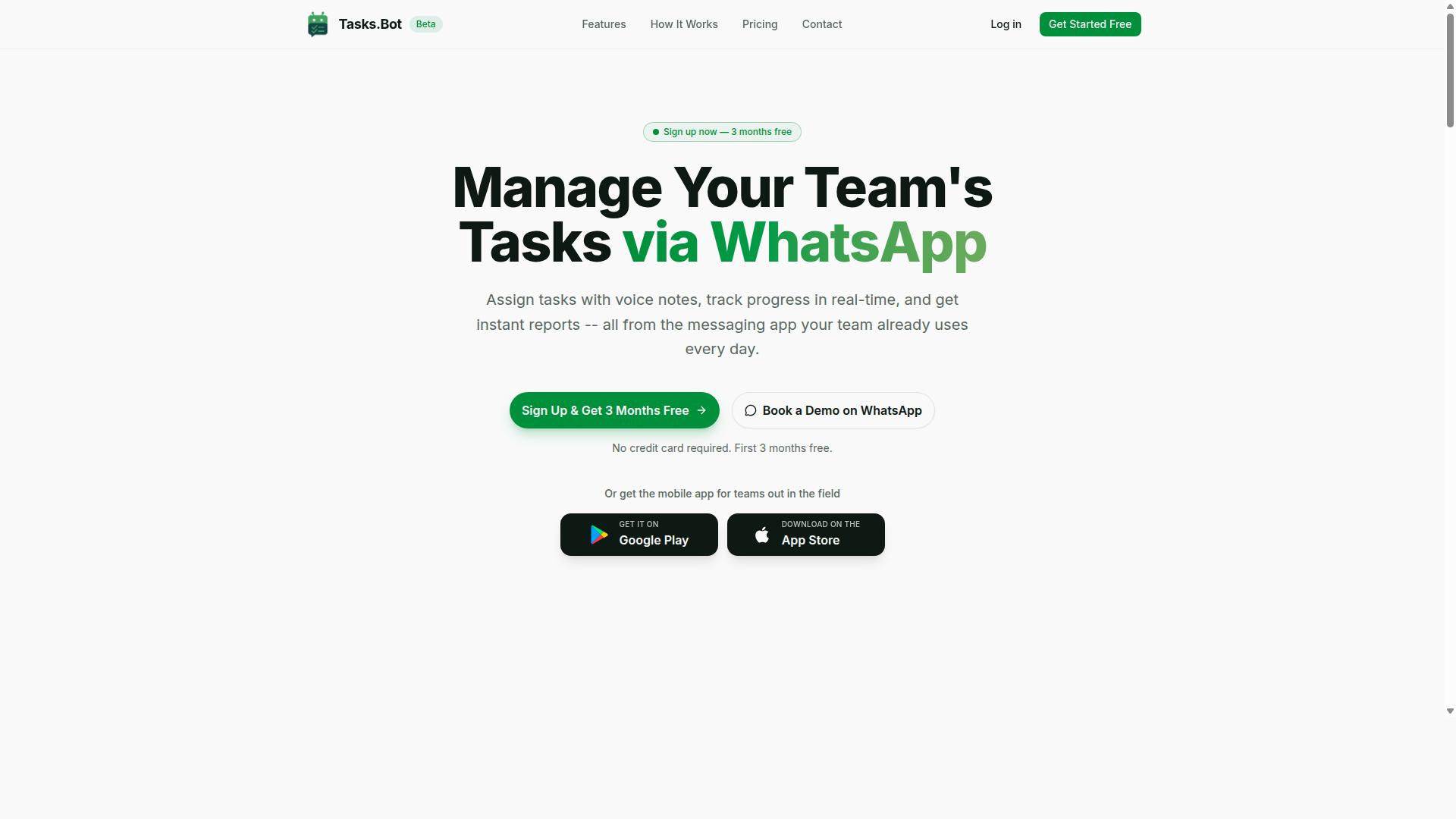
Tasks.Bot is a task management platform that operates entirely within WhatsApp, letting teams assign tasks, track progress, and receive reports without leaving the messaging app they already use. There is no new app to install and no separate account to create. For most teams, WhatsApp is already open on every phone, so adoption starts at zero friction.
That matters more than it sounds. Most task tools fail because people stop opening them. Tasks.Bot removes that barrier by putting task management inside a channel people already check daily. A mobile app for field teams is also available for Android and iOS, with push notifications, voice capture, and a home screen widget.
The platform uses AI to understand user intent and create tasks directly from messages. Users can also create tasks by sending a voice note, which is useful for anyone working hands-free or on the move. Beyond task creation, the feature set covers automatic task assignment, smart deadline reminders, approvals and automations, instant reports, tasks on a map, a live day tracker, face-verified attendance, and shifts, leave, and hours management.
Tasks.Bot is currently in beta and offers a free trial period, so teams can evaluate it before committing. Its automation does not stop at messaging either. It extends into webhook-driven workflows, which is where the next section picks up.
How Tasks.Bot Handles AI Task Automation and Webhook-Driven Workflows
Tasks.Bot processes incoming messages and voice notes through AI to extract task details, then triggers automated workflows that can include webhook calls to external systems. The flow is straightforward: a user sends a WhatsApp message or a voice note, the AI parses it into a structured task, and predefined automations run from there.
Those automations can cover things like approvals and notifications. Instead of a manager manually chasing a sign-off, the workflow can route the request and alert the right person. This is workflow automation built on trigger events, not a separate system someone has to remember to open.
Webhooks add the outward-facing half. When a task is created or updated, Tasks.Bot can send that data to other tools through an HTTP callback. Common uses include updating a project management system or triggering a custom script. Each call carries a JSON payload describing the task, which the receiving system reads and acts on.
This is what makes webhooks useful rather than decorative. They turn Tasks.Bot into a hub for task orchestration, where a single message can ripple outward into the rest of a team's stack. In practice, that means a few things:
- Task data can flow to a project management system without manual re-entry.
- A custom script can run automatically when a task changes state.
- Approvals and notifications can fire as part of the same event chain.
For readers comparing platforms, the practical questions around any webhook integration are consistent. How is the request authenticated, through an authentication token or an HMAC signature? What happens when a receiving API endpoint is down, and is there a retry mechanism? Does the platform support idempotency so a repeated delivery does not create duplicate records? How does it handle rate limiting and payload delivery under load?
Those questions matter because event-driven automation only helps if it is reliable. Latency, throughput, and delivery guarantees determine whether a webhook-driven workflow feels like a system or a gamble. Teams evaluating a Zapier alternative, Make alternative, n8n, IFTTT, or Microsoft Power Automate should apply the same checklist to every option, including how a no-code automation or low-code platform exposes its REST API and action execution.
Tasks.Bot's advantage in this comparison is where the automation begins. Because the trigger is a WhatsApp message or voice note rather than a form or dashboard, the people closest to the work can start a workflow in seconds. The AI handles the parsing, and the webhook layer handles the handoff to everything else.
Does Tasks.Bot Support AI Task Automation Webhooks Like TaskRio?
Yes, Tasks.Bot supports webhook-driven automation, but its approach differs from TaskRio's developer-centric model by embedding webhook triggers within a WhatsApp-first interface. That single design decision shapes everything about how the two platforms handle event-driven automation.
TaskRio has built a reputation around robust webhook support and API endpoints. Teams comfortable with code can wire up custom listeners, fine-tune request headers, and route events with precision. Tasks.Bot takes a different path. Its webhook capabilities live inside a broader automation feature set, and the whole experience is built for people who would rather not open a code editor.
So the honest answer is yes, Tasks.Bot supports webhook integration for AI task automation. It just packages that power differently.
When tasks move through Tasks.Bot, the platform can fire HTTP callbacks with JSON payloads at key moments. That covers the three trigger events most teams care about:
- A task is created
- A task is updated
- A task is completed
Those callbacks let an external system react the moment something changes. A CRM record can update itself. A reporting dashboard can refresh. A billing tool can log a milestone. This is classic event-driven automation, and it works without anyone writing a listener from scratch.
TaskRio tends to appeal to engineering teams that want granular control over payload delivery, retry mechanisms, and authentication tokens. Tasks.Bot trades some of that depth for accessibility. The webhook still fires, the JSON still arrives, but the setup happens through a WhatsApp-first interface rather than a developer console.
That trade-off matters more than it sounds. A team that never touches webhooks because the setup feels intimidating gets zero value from granular control. A team that can switch on callbacks in minutes gets real workflow automation immediately.
There is a practical angle here too. Because Tasks.Bot operates entirely within WhatsApp, team members don't need to install anything or create new accounts. The same people creating and completing tasks are the ones whose actions trigger the webhooks. There is no separate admin layer, no seat management headache, and no onboarding friction standing between a completed task and the automation it should set off.
For teams weighing a Zapier alternative, a Make alternative, or a lighter option than n8n, the question is usually not "which platform has the deepest API?" It is "which platform will my team actually use?" TaskRio answers the first question well. Tasks.Bot answers the second.
Security deserves a mention on both sides. Webhook security typically involves HMAC signatures or authentication tokens so that receiving systems can verify a payload genuinely came from the sender. Tasks.Bot backs its automation layer with enterprise-grade encryption, and conversations and task data are never shared or used for training. That matters when webhook payloads carry task titles, assignee names, or status changes.
On reliability, the usual concerns apply to any webhook setup: delivery guarantees, idempotency, rate limiting, latency, and throughput. These are engineering trade-offs every automation platform navigates, and the right answer depends on how much control your team needs versus how much simplicity it wants.
There is also a cost-of-entry question. Tasks.Bot offers a 3-month free trial with no credit card required, which gives teams room to test webhook behavior against their actual workflows before committing. That is a meaningful advantage when you are comparing platforms and want evidence rather than a sales pitch.
The verdict is straightforward. Tasks.Bot does support AI task automation webhooks, and it does so in a way that fits teams who value no-code automation over low-code platform tinkering. TaskRio may offer more granular control for developers. Tasks.Bot offers a simpler, more accessible route to the same destination: tasks that trigger actions elsewhere, automatically, the moment they change.
Key Features That Power Tasks.Bot's Automation
Tasks.Bot's automation capabilities are built on a set of core features designed to minimize manual input and maximize efficiency for teams on WhatsApp. Instead of asking users to learn a new dashboard or fill out long forms, the platform works inside the messaging app most teams already use every day.
What makes these features valuable is not any single one on its own. It is how they connect. A voice note becomes a task, that task gets assigned to the right person, approvals and reminders keep it moving, and reports show what happened. That chain is what turns AI task automation into something a team can actually rely on.
The sections below break down each part of that chain in detail:
- Voice notes, natural language parsing, and automatic task assignment
- Approvals, smart deadline reminders, and instant reports
Each feature is powered by the same underlying AI that understands user intent and creates tasks from messages. Read together, they show why Tasks.Bot functions as a complete task orchestration layer rather than a simple to-do list.
Voice Notes, Natural Language Parsing, and Automatic Task Assignment
Tasks.Bot uses AI to convert voice notes and free-text messages into structured tasks, then automatically assigns them to the right team member. A user can record a quick voice note on WhatsApp instead of typing out a formal request, and the platform extracts the details that matter.
Natural language parsing works the same way for typed messages. A user can write a request in plain language, and Tasks.Bot creates the task from it. There is no separate form, no dropdown menus, and no manual data entry step.
Automatic assignment removes another layer of friction. Tasks can be routed so the right person receives the work without a manager sorting through a queue. This matters most for teams handling field jobs, service requests, or any high-volume flow of small tasks.
The practical result is speed. A request that once took several messages and a follow-up to organize becomes a single message that produces a tracked task. That reduction in manual input is the foundation the rest of Tasks.Bot's workflow automation builds on.
Approvals, Smart Deadline Reminders, and Instant Reports
Tasks.Bot automates approval workflows, sends smart deadline reminders, and generates instant reports to keep projects on track without manual follow-ups. Together these features handle the oversight work that usually falls on a manager's plate.
Approvals let a task require manager sign-off before it is marked complete, with automated notifications keeping everyone informed along the way. Nothing gets closed out silently, and the person who needs to review the work knows it is waiting.
Smart deadline reminders arrive through WhatsApp, taking task priority and user behavior into account rather than firing off a fixed alert schedule. Reminders reach people where they already are, which makes them far more likely to be acted on than an email sitting in an inbox.
Instant reports give managers on-demand summaries of task status, completion rates, and bottlenecks. These can be delivered as WhatsApp messages or exported when a deeper review is needed. For teams that need a quick read on where things stand, that removes the wait for someone to compile a status update by hand.
Each of these features chips away at the same burden: the constant checking, chasing, and reporting that consumes management time. Tasks.Bot handles that oversight automatically, so the team can focus on the work itself rather than the coordination around it.
Webhook Support: How Tasks.Bot Connects to Your Existing Tools
Tasks.Bot's webhook support enables it to send real-time HTTP callbacks to external systems whenever specific task events occur, facilitating seamless integration with your existing tools. Instead of forcing you to poll an API for updates, the platform pushes data out the moment a trigger event fires. That shift from polling to an event-driven automation model is what keeps integrations responsive.
In practice, this means you configure a URL, sometimes called an API endpoint, and Tasks.Bot delivers a JSON payload to it via an HTTP POST request. That payload carries the task data your receiving system needs to act on. The receiving side can be almost anything: a REST API, a serverless function, a no-code automation platform, or an internal service.
Because webhooks are user-configurable, you decide which events matter. You are not locked into a fixed set of triggers. That flexibility is a key reason teams compare webhook handling closely when weighing AI task automation platforms.
Webhook security deserves attention because a public endpoint is an open door if left unguarded. Two common safeguards are authentication tokens and HMAC signatures. A token works like a shared secret: the receiver checks it before processing anything. An HMAC signature goes further by hashing the payload with a secret key, so the receiver can verify both authenticity and that the content was not altered in transit.
- Authentication tokens: a secret value sent with each request and validated by the receiver.
- HMAC signatures: a cryptographic hash that confirms the payload came from a trusted source and was not tampered with.
- HTTPS enforcement: delivering over TLS so payloads are encrypted in transit.
Reliability separates a dependable webhook integration from a fragile one. Networks drop connections, servers restart, and endpoints go briefly offline. A solid retry mechanism with exponential backoff handles this by reattempting failed deliveries at growing intervals rather than hammering a struggling endpoint. This improves the odds of eventual delivery without overwhelming the receiver.
Two related concepts matter for correctness. Rate limiting caps how many callbacks fire in a given window, protecting both sender and receiver from traffic spikes. Idempotency ensures that if the same event is delivered more than once, the receiving system does not perform the same action twice. Without idempotency, a retried delivery could create duplicate calendar events or double-charge a record in a CRM.
Practical safeguards to look for in any automation platform include:
- Retry logic with backoff and a defined maximum attempt count.
- Idempotency keys embedded in each payload so receivers can deduplicate.
- Configurable rate limits aligned with the receiving endpoint's capacity.
- Delivery logs that show success, failure, and response codes for each attempt.
These details affect latency, throughput, and scalability. When an endpoint receives a manageable, verified stream of events, workflow automation stays predictable even as task volume grows.
Concrete examples show how this plays out. You might point a webhook at Zapier, Make, or n8n to bridge into hundreds of third-party integrations without writing code. A no-code automation platform can then route the payload into conditional logic and action execution.
Common uses include:
- Creating a calendar event when a task reaches its due date.
- Updating a CRM record when a lead-related task is completed.
- Posting a message to a team channel when a milestone is hit.
- Calling a custom REST API to sync data with an internal system.
For teams evaluating a Zapier alternative or Make alternative, the quality of webhook support often decides the choice. A low-code platform that handles security, retries, and deduplication well removes a large share of integration headaches. When assessing any option, check how it signs payloads, how it behaves on failure, and whether it gives you visibility into delivery history.
For anyone weighing TaskRio against Tasks.Bot, webhook support is a fair place to focus. Look for clear documentation on authentication, retry behavior, and idempotency, since these determine whether your task orchestration stays reliable at scale. Strong webhook handling is what turns a standalone tool into a connected part of your workflow.
Pricing and Plans: Full Access With No Feature Tiers
Tasks.Bot offers a single 'Full Access' plan that includes every feature, with pricing in Indian Rupees and US Dollars, and no hidden tiers or add-ons. That structure stands out in a market where many AI task automation platforms split webhook support, API access, or approval flows across starter, pro, and enterprise packages.
For teams comparing tools on total cost of ownership, the difference matters. A lower headline price often hides the real spend once you upgrade for the capabilities you actually need. Tasks.Bot avoids that pattern entirely by charging one rate for the whole platform.
The plan is priced per member, which keeps costs predictable as a team grows. There is no separate fee for individual capabilities, so voice notes, webhooks, approvals, and other features all sit inside the same subscription.
| Plan | Price | Effective Monthly Cost |
|---|---|---|
| Monthly | ₹200 per member per month | ₹200 |
| Annual | ₹1,200 per year per member | ₹100 |
The annual option works out to ₹100 per month, a 50% saving that adds up to ₹1,200 saved per member each year. For a ten-person team, that is a meaningful reduction in the automation budget without giving up any functionality.
Pricing is also available in US Dollars. The site presents a currency selector with Indian Rupee and US Dollar options, so international teams can view rates in their preferred denomination before committing. Verifying the displayed currency during checkout is a sensible step for anyone billing across regions.
New users can explore the platform through 3 months free, with no credit card required and the ability to cancel anytime. That removes the usual friction of a paid trial and lets teams evaluate webhook delivery, trigger events, and conditional logic in their own environment first.
Because every capability ships in one plan, budgeting becomes simpler. There is no need to forecast which tier a growing team will outgrow, and no surprise upgrade when a workflow starts using more advanced features. One line item covers the whole platform.
For finance and operations leads, this flat structure also reduces procurement overhead. Approvals, renewals, and seat changes follow a single, predictable formula rather than a matrix of feature bundles. That clarity is rare among low-code and no-code automation tools, where pricing pages often run several screens long.
Trust Signals: Beta Status, Encryption, and Refund Policy
Tasks.Bot is currently in beta, which means it's actively evolving, but it already implements encryption and offers a refund policy to mitigate risk for early adopters. For teams evaluating an automation platform for webhook support, that combination matters. Beta status tells you the product is still being shaped, while encryption and a stated refund policy tell you the basics of webhook security and customer protection are not being ignored.
The key question for any buyer is simple. Does the platform treat trust as a core feature, or as an afterthought? With Tasks.Bot, the signals point toward the former, even if the product has not yet reached a final release.
Beta status is often misunderstood. It does not mean a tool is unfinished or unsafe. It means the team is still shipping changes quickly and, in most cases, listening closely to feedback from the people using the product. For an AI task automation tool handling webhook integration, that responsiveness can be an advantage. A bug in payload delivery or a gap in retry behavior can be reported and addressed faster than in a slow, locked-down release cycle.
Simultaneously, beta status comes with honest limitations. Features may change, interfaces may shift, and documentation may lag behind the product. Buyers should plan for that reality rather than assume a frozen, final-state tool. The trade-off is straightforward. You get earlier access and a louder voice in how the product develops, but you accept that some things will move under your feet.
Encryption is the second trust signal, and it is the one that matters most for webhook support. Webhooks carry data between systems, often through an HTTP callback to an API endpoint. That data can include JSON payloads with identifiers, statuses, and sometimes sensitive business information. Encryption in transit protects that traffic as it moves across the network, while encryption at rest protects stored data when it is not in use.
For teams comparing TaskRio and Tasks.Bot on webhook security, this is a fair point of scrutiny. A platform that encrypts data in transit and at rest reduces the exposure created by interception or unauthorized access to stored records. It does not replace good practices like authentication tokens, HMAC signature verification, or idempotency keys, but it forms the baseline layer those practices sit on.
Encryption also supports reliability in a practical sense. When payload delivery is protected, teams can build event-driven automation with more confidence, knowing that the data crossing between systems is not left open to tampering.
The refund policy mentioned in the footer of the Tasks.Bot site is a third trust signal, and it functions as a safety net. Early adopters take on more uncertainty than late buyers, so a stated refund option lowers the cost of being wrong. If the platform does not fit a team's workflow automation needs, there is a documented path out rather than a dead end.
For anyone weighing a beta product against a more established option, that policy is worth reading in full before committing. It answers a simple question. What happens if this does not work for us? A clear answer reduces the risk of trying something new.
Tasks.Bot also offers a Book a Demo on WhatsApp option, which gives prospective users a direct way to ask questions before signing up. For teams with specific concerns about webhook support, rate limiting, or delivery guarantees, that conversation can clarify what the platform does and does not handle today.
Field teams have an additional trust feature worth noting. Face-verified attendance adds a layer of accountability for teams that need to confirm who was present at a job site or shift. In an automation context, that kind of verification feeds cleaner data into workflow automation, since attendance records are less likely to be disputed or falsified.
It is also worth being transparent about what beta status means for scalability and uptime expectations. A product still in development may not yet publish the same long-term reliability figures as a mature platform. Buyers should ask direct questions about throughput, latency, and how the retry mechanism behaves under load. Those answers matter more than marketing language.
Taken together, the trust picture for Tasks.Bot is reasonable for an early-stage tool. It is in beta, so change is expected. It encrypts data in transit and at rest, which covers the core of webhook security. It offers a refund policy in the footer, which limits downside risk. It provides a direct demo channel on WhatsApp, and it includes face-verified attendance for field teams that need verified records.
None of this makes Tasks.Bot a finished, risk-free product, and the company does not appear to claim otherwise. What it does show is a commitment to security and customer satisfaction while the platform matures. For teams evaluating AI task automation with webhook support, that is a fair and honest starting point, and a reasonable basis for trying the tool rather than waiting on the sidelines.
Who Should Use Tasks.Bot for AI Task Automation
Tasks.Bot is ideal for teams that already rely on WhatsApp for communication, especially those with field staff who need task management, attendance tracking, and payroll-ready hours. Instead of forcing workers onto a new app, the platform meets them inside the messaging tool they already open every day.
That single design choice removes one of the biggest barriers to adoption in AI task automation: app fatigue. When staff do not have to download, learn, or remember another login, the odds of consistent daily use rise sharply.
Small to medium businesses form the clearest fit. These organizations often run lean operations where managers cannot spend hours chasing status updates, and Tasks.Bot handles task assignment automatically so work keeps moving without manual follow-up.
Field service teams are another natural match. Crews spread across job sites can receive assignments, confirm completion, and log hours through WhatsApp rather than returning to a desk to fill out forms. Attendance tracking and payroll-ready hours flow from the same activity, cutting duplicate admin work at the end of each pay period.
Remote teams benefit for similar reasons. Distributed staff are already comfortable with messaging-first workflows, and keeping task orchestration in one familiar channel reduces the friction that comes with juggling separate project tools.
Webhook integrations matter most for organizations that already run other systems. Tasks.Bot connects to existing platforms through webhook support, so task events can flow into the tools a business already depends on rather than creating another data silo.
- Businesses that want automation without replacing their current stack
- Teams connecting task activity to third-party systems through an API endpoint
- Operations that need event-driven automation tied to real field activity
This makes Tasks.Bot a practical fit for companies that treat it as one layer in a broader workflow rather than a full rip-and-replace project.
Anyone who treats WhatsApp as the primary communication channel should look closely at Tasks.Bot. The service is globally available and already supports hundreds of teams, which speaks to how well the WhatsApp-first model travels across regions and industries.
The common thread across all these profiles is simple. If your people live in WhatsApp and your pain points are task assignment, attendance, and hours tracking, Tasks.Bot was built for exactly that combination.
Final Verdict: Tasks.Bot vs TaskRio for Webhook Automation
When comparing Tasks.Bot and TaskRio for webhook automation, the choice depends on whether you prioritize a WhatsApp-native, no-code experience or a developer-focused, API-first platform. Both tools support webhook integration, but they serve different audiences with different expectations around setup speed, control, and technical depth.
Tasks.Bot is built for teams that want quick adoption and automation that lives inside WhatsApp. Its webhook support connects trigger events to action execution without requiring deep engineering work, which matters for small teams, operations staff, and founders who need workflow automation running today rather than after a sprint cycle. The platform also includes built-in task management, so webhook-driven events feed directly into an organized system rather than a separate tool.
TaskRio takes the opposite approach. It leans toward advanced webhook customization and developer tooling, which suits technical teams comfortable with a REST API, custom API endpoints, and finer control over JSON payload structures. If your workflow depends on precise payload delivery, conditional logic at the code level, or custom authentication token handling, TaskRio's developer-first design may fit better.
The table below summarizes the practical differences based on publicly available information about each platform.
| Consideration | Tasks.Bot | TaskRio |
|---|---|---|
| Primary audience | Non-technical teams, WhatsApp users | Developers, technical teams |
| Setup approach | No-code, fast adoption | API-first, configuration-heavy |
| Webhook support | Built-in alongside task management | Advanced customization and developer tools |
| Best fit | Automation inside WhatsApp | Deep API control and custom integrations |
For teams weighing a Zapier alternative or Make alternative that keeps automation close to where conversations already happen, Tasks.Bot removes the friction of stitching together separate tools. For engineering-led teams that treat event-driven automation as a core system with strict reliability, latency, and throughput requirements, TaskRio's deeper control surface is the more natural match.
The balanced verdict: neither platform wins outright. Tasks.Bot wins on simplicity, WhatsApp integration, and built-in task management with webhook support. TaskRio wins on customization depth and developer tooling. The right question is not which is better, but which matches your team's technical capacity and where your workflows actually run.
If quick adoption and automation within WhatsApp are your priorities, exploring Tasks.Bot's demo is a practical first step to see how its webhook support fits your workflows. For further inquiries, you can reach the team by phone at +91 97143 42522 or by email at [email protected].
Frequently Asked Questions
What makes Tasks.Bot different from other AI task automation tools when it comes to webhook support?
Tasks.Bot is built around WhatsApp, so task creation, assignment, reminders, approvals, and reports all happen inside the messaging app your team already uses. That means automation triggers and updates reach people where they actually work, rather than requiring them to log into a separate dashboard. If your team lives in WhatsApp, this removes a major adoption barrier that standalone task tools often run into.
Do my team members need to install an app or create new accounts to use Tasks.Bot?
No. Tasks.Bot operates entirely within WhatsApp, so team members don't need to install anything or create new accounts to receive tasks, get reminders, or submit updates. A mobile app is also available for field teams who need it. This keeps onboarding simple, especially for field staff who may not be comfortable with new software.
How does Tasks.Bot's AI handle task creation compared to typing tasks manually?
Tasks.Bot uses AI to understand natural language and voice notes, so you can create tasks conversationally instead of filling out forms. Tasks can be assigned automatically, with smart deadline reminders and approvals handled through automations. This is especially useful for teams that need to capture tasks quickly while on the move.
How much does Tasks.Bot cost, and is there a free trial?
Tasks.Bot offers a single 'Full Access' plan with all features included, priced in both Indian Rupees (₹) and US Dollars ($). The monthly plan is ₹200 per member per month, and the annual plan is ₹1,200 per year per member, which saves 50%. The service is currently in beta, and the site mentions a refund policy in the footer, so it's worth checking current details before subscribing.
Can Tasks.Bot handle attendance and field team tracking, or is it only for tasks?
Tasks.Bot goes beyond simple task lists: it includes face-verified attendance, tasks on a map, and live day tracking, which are designed for teams with field staff. It also supports payroll-ready hours, so attendance and work data can feed into payroll processes. For teams managing remote or on-site field workers, these features reduce the need for separate attendance tools.
How can I see Tasks.Bot in action before committing?
The website includes a 'Book a Demo on WhatsApp' option, so you can experience the workflow directly in the app rather than watching a generic product tour. You can also reach the team at [email protected] or +91 97143 42522 with questions. Since the service is in beta, a demo is a good way to confirm it fits your team's specific automation needs.
Recommended Resources: