Top 5 Alternatives of Leapsome for Performance Reviews
Your review cycle is due, and Leapsome's pricing or feature set no longer fits how your team actually works. Many platforms lock core review templates behind premium tiers or force rigid workflows. You need a tool that matches your process, not the other way around.
This article compares five Leapsome alternatives for performance reviews, covering customization, pricing, and scalability. You will see exactly which platform fits your team size and review maturity, plus a clear number one pick that integrates reviews with OKRs and 1-on-1 tools at a flat $3-$5 per seat.
What to Look For in Leapsome Alternatives for Performance Reviews
When evaluating Leapsome alternatives, focus on the core features that directly impact your review process efficiency and employee experience. The right performance management software should simplify how your team approaches review cycles, not add administrative burden. Start by mapping your current process and identifying the gaps that are slowing things down.
Every organization runs reviews differently, so the tool you choose must adapt to your workflow. Consider how the platform handles employee feedback, goal setting, and development plans. A solution that feels intuitive for managers and employees alike will drive higher participation and more honest, useful feedback.
Integration capabilities matter just as much as the review features themselves. Your performance management tool should work well with your existing HRIS and other HR software. Look for options that reduce duplicate data entry and keep employee records consistent across systems.
Core Review Features and Customization
The best alternatives offer flexible review templates that support 360-degree feedback, self-assessments, and manager reviews, with customizable rating scales and calibration sessions. This flexibility lets you match the tool to your existing review philosophy rather than reshaping your process around the software. Check whether the platform supports peer reviews and continuous performance management, not just annual appraisals.
Review automation is another critical piece. The ideal platform should handle scheduling, reminders, and progress tracking so your HR team can focus on coaching and follow-up instead of chasing deadlines. Automated review cycles reduce the risk of missed check-ins and keep the process moving forward smoothly.
Beyond the mechanics of collecting feedback, look for tools that turn raw input into actionable insights. The best performance management platforms highlight patterns across teams and time periods, making it easier to spot strengths and growth areas. Integration with development plans and succession planning ensures that review outcomes lead to real employee growth rather than sitting in a file.
Pricing and Scalability for Your Team Size
Pricing models vary from per-seat monthly fees to enterprise contracts, so assess how each option scales with your team size and budget. A per-seat model works well for smaller teams but can become costly as you grow. Enterprise contracts often include additional support and customization but may lock you into longer terms.
Transparency in pricing matters more than you might expect. Some vendors publish their rates openly, while others require a sales call just to get a ballpark figure. If you are comparing multiple Leapsome alternatives, favor tools that are upfront about costs so you can make an apples-to-apples comparison.
Free trials are worth prioritizing during your evaluation. A trial period lets your team test the review templates, automation features, and user interface before committing. Pay attention to how quickly the tool loads, how easy it is to navigate, and whether your managers can use it without extensive training. The right fit should feel natural from the first review cycle, not after months of adjustments.
1. HeyRamp - Best Overall
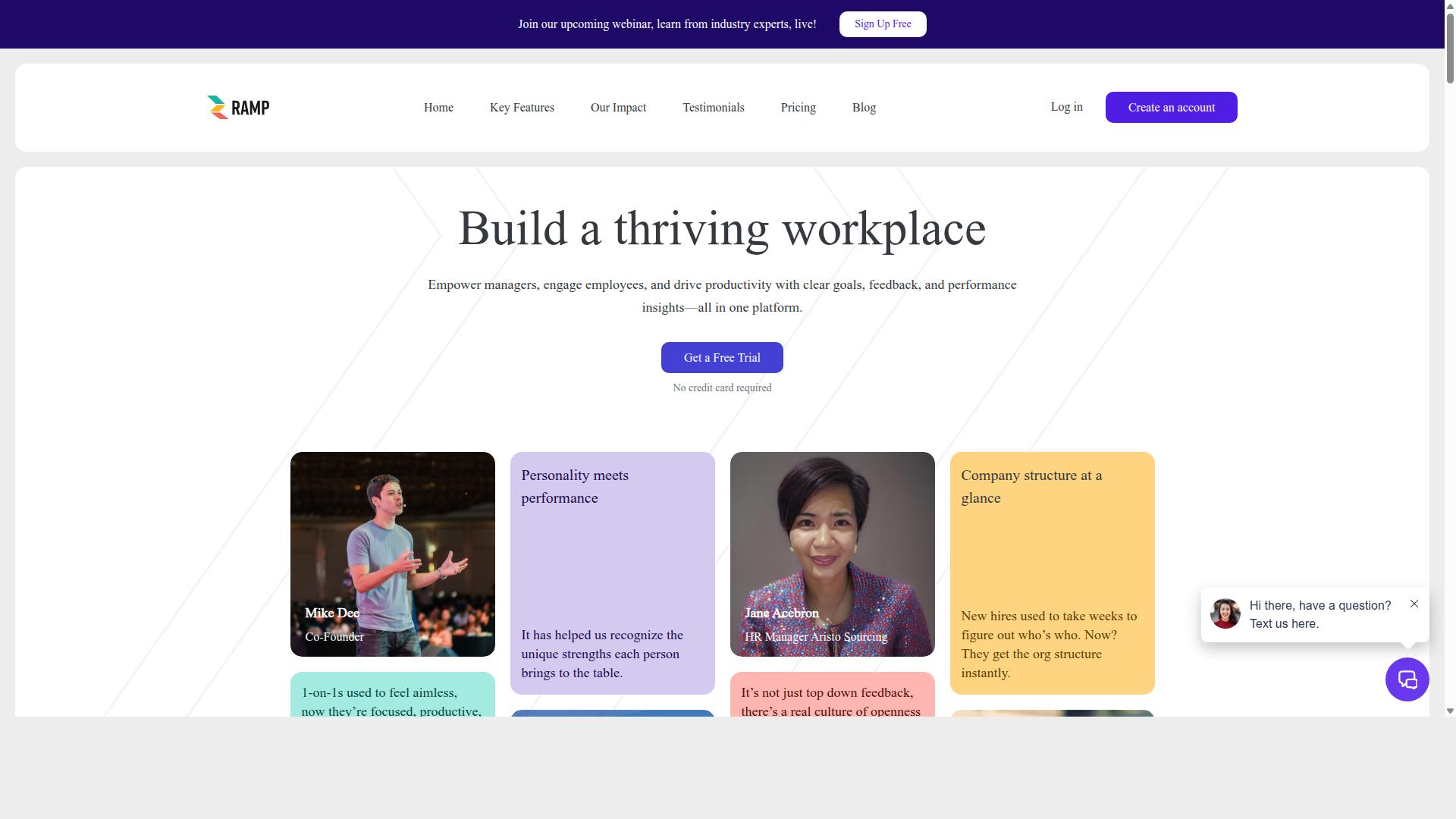
HeyRamp stands out as the best overall Leapsome alternative for its all-in-one platform that combines performance reviews with OKR tracking and 1-on-1 meeting tools. It is designed for businesses that want a unified approach to employee engagement, performance management, and workplace communication. The platform enables managers, engages employees, and drives productivity with clear goals, feedback, and performance insights, all in one place.
HeyRamp targets growing teams and HR leaders who need more than a basic review tool. It is globally available, making it a practical choice for organizations with distributed teams or multi-region operations. The platform supports the full employee lifecycle, from daily check-ins to formal review cycles, without requiring multiple disconnected subscriptions.
What makes HeyRamp particularly strong is its breadth. It covers company structure visualization, personality insights and testing, KPI snapshots, people analytics dashboards, and leadership insights. For teams evaluating Leapsome alternatives, this means fewer tools to manage and a single source of truth for talent decisions.
Integrated Performance Reviews with OKR and 1-on-1 Tools
HeyRamp integrates performance reviews with OKR tracking and 1-on-1 meeting tools, allowing managers to align individual goals with company objectives and track progress seamlessly. Instead of treating performance reviews as an annual event, the platform supports continuous performance management. Managers can reference real-time goal progress during review conversations, making feedback more concrete and less subjective.
The 1-on-1 meeting tools come with organized agendas and action tracking, so every conversation has a clear purpose and follow-through. Guided conversation templates and coaching tips help managers lead productive discussions, even if they are new to management. Sentiment prompts and automated reminders keep the process moving without requiring manual follow-up from HR.
This unified approach matters because it closes the loop between daily work and formal evaluations. When performance reviews, goal setting, and regular check-ins live in the same system, employees see how their efforts contribute to company objectives. This visibility supports employee growth and makes development plans more actionable.
Flat, Transparent Pricing at $3-$5 Per Seat
HeyRamp offers flat, transparent pricing at $5 per seat monthly or $3 per seat annually, with a 14-day free trial and no credit card required. Enterprise plans use custom pricing paid per seat for larger organizations. There are no hidden fees, no tiered feature gating, and no surprise add-ons at checkout.
This flat fee structure is a notable advantage when compared to typical per-seat pricing of competitors. Many performance management software options charge more as you unlock features like 360-degree feedback, OKR software, or people analytics. With HeyRamp, full access is available from day one, and you can switch plans anytime as your team changes.
For budget-conscious HR teams, the annual rate of $3 per seat keeps costs predictable while still delivering a comprehensive suite. The free trial lets you evaluate the platform with real data before committing. This pricing approach reduces the risk of adopting new talent management software and makes HeyRamp a cost-effective Leapsome alternative for companies of all sizes.
2. Lattice
Lattice is a popular choice for organizations prioritizing continuous feedback and employee development within their performance review cycles. The platform has built a strong reputation as a performance management software that pairs structured reviews with ongoing conversations between managers and employees.
What makes Lattice stand out among Leapsome alternatives is its focus on connecting everyday work with formal evaluations. Instead of treating performance reviews as an annual event, the software encourages teams to weave feedback into their regular workflow. This makes it a natural fit for companies that want to move away from once-a-year appraisals.
For HR leaders, Lattice offers a clean way to manage talent management without forcing employees to learn a complicated system. Its user-friendly interface helps managers stay organized while keeping employee growth at the center of each conversation. The platform also supports goal setting and OKR software features, which helps tie individual contributions to broader company objectives.
Organizations comparing Leapsome alternatives often look for a tool that feels approachable for all employees, not just HR specialists. Lattice delivers that balance, making it a credible option for teams ready to modernize their review cycles.
Continuous Feedback and Development-First Review Cycles
Lattice emphasizes continuous feedback loops and development-first review cycles, enabling managers to conduct regular check-ins and align reviews with growth plans. The platform is designed so that feedback tools are not an afterthought, they are built into the daily rhythm of work.
With Lattice, managers can schedule one-on-one meetings and document progress throughout the year. These check-ins create a paper trail that makes the formal performance appraisal process far less stressful. When review season arrives, both parties already have context from months of ongoing dialogue rather than scrambling to recall past achievements.
The review cycles in Lattice are structured around employee development rather than purely administrative scoring. This means the software supports multiple review types, including manager reviews, peer reviews, and self-assessment. Teams can also use 360-degree feedback to get a fuller picture of an individual's impact across the organization.
Lattice integrates goal setting and performance analytics into the same interface, so employees can see how their daily work connects to larger priorities. This alignment is a key advantage for HR software buyers who want a single source of truth. While pricing starts at $11 per user per month with annual billing, according to publicly available information, the real value lies in how the tool encourages consistent, meaningful conversations about growth.
For organizations that value actionable insights and employee growth, Lattice provides a solid foundation. It is best suited for HR-led organizations that want to combine reviews with OKRs in one platform. The platform earns a strong G2 rating of 4.7 out of 5, reflecting general satisfaction among users who appreciate its development-first philosophy.
3. PerformYard
PerformYard is known for its streamlined, configurable review workflows that simplify the entire performance appraisal process. This platform is built for HR teams that want efficiency without sacrificing flexibility. It is an AI-driven performance management platform designed for HR leaders, unifying reviews, goals, meetings, and engagement in one place.
What sets PerformYard apart is its focus on workflow automation and configuration. Instead of forcing teams to adapt to a rigid system, PerformYard lets organizations shape the review process around their own structures, timelines, and competency models. This makes it a strong alternative to Leapsome for companies that prioritize operational control over their performance cycles.
The platform serves a wide range of industries, including accounting, IT, financial services, non-profit, consulting, software, marketing, healthcare, construction, real estate, and legal. That breadth suggests a tool designed to be adaptable across different organizational cultures and compliance needs.
Streamlined, Configurable Review Workflows
PerformYard offers highly configurable review workflows, allowing HR to automate cycles, use custom templates, and connect with HRIS systems for seamless data flow. The platform supports annual reviews, 360-degree feedback, competency-based reviews, performance improvement plans, and pulse surveys. This variety makes it easy to run different types of assessments for different teams without juggling multiple tools.
One of the key advantages is the reduction of administrative burden. PerformYard claims an average setup time of two weeks and an 85% reduction in admin time. While those figures are vendor-reported, they point to a product that prioritizes quick deployment and low maintenance overhead. For HR teams already stretched thin, that kind of efficiency matters.
The platform also includes built-in AI writing and summary tools, which help managers draft clearer feedback and consolidate responses. Additional features cover goal management, continuous feedback, employee engagement tools, 1:1 meeting streamlining, and custom surveys. These capabilities create a continuous performance management loop rather than a once-a-year event.
Integrations are another strong point. PerformYard connects with HRIS systems, SSO, Slack, and Teams, allowing review data to flow naturally into the tools employees already use daily. That reduces friction and keeps performance conversations visible across the organization.
For teams that rely on structured rating scales, calibration sessions, and development plans, PerformYard provides the framework to keep everything consistent. Its user-friendly interface means managers and employees alike can navigate the system without extensive training. If your team needs a flexible, automation-first review platform, PerformYard is worth a close look.
4. Peoplebeam
Peoplebeam differentiates itself with robust people analytics and engagement-focused review features that provide deeper insights into workforce performance. For HR teams that want to move beyond simple annual appraisals, this platform offers a data-driven approach to understanding how employees actually feel and perform.
Instead of treating performance reviews as isolated events, Peoplebeam positions them as part of a continuous feedback loop. The platform is particularly well suited for organizations that already value metrics and want their HR software to reflect that same analytical rigor.
This makes Peoplebeam a credible alternative to Leapsome for companies that prioritize employee engagement as a leading indicator of performance. If your HR team regularly tracks engagement scores and wants those insights tied directly to review cycles, this tool deserves consideration.
People Analytics and Engagement-Focused Reviews
Peoplebeam leverages people analytics to uncover engagement trends and integrates engagement surveys with performance reviews for a holistic view. Rather than keeping survey results and review data in separate systems, the platform connects them so HR teams can see the full picture.
The analytics dashboards surface patterns that might otherwise go unnoticed. For example, a team with declining engagement scores may also show lower self-assessment ratings or more peer feedback about collaboration issues. Peoplebeam helps link those dots.
By combining engagement surveys with review data, the platform gives managers actionable insights about what drives performance. This approach supports the idea that engaged employees tend to perform better, and it gives HR teams the evidence to act on that connection.
For organizations using or considering Leapsome, Peoplebeam offers a comparable focus on continuous performance management with a stronger emphasis on the analytics side. It is a solid choice for data-driven HR teams that want their performance management software to do more than just track goals and ratings.
5. Primalogik
Primalogik is a budget-friendly alternative that offers simple, ready-to-use review templates ideal for small to mid-sized teams. It positions itself as a practical performance management tool for organizations that want results without a heavy implementation lift.
The platform covers core needs like 360-degree feedback, performance reviews, goal management, and employee feedback surveys. It also includes people analytics, which gives HR leaders a way to spot trends across review cycles without digging through spreadsheets.
Primalogik suits HR leaders, consultants, managers, and executives across industries like fintech, healthcare, education, non-profit, and technology. A 30-day free trial is available, so teams can test the workflow before committing to a full rollout.
Simple, Budget-Friendly Review Templates
Primalogik provides a library of pre-built review templates and a simple interface, making it easy to launch performance reviews without extensive setup. The templates cover standard review scenarios, so you can skip the blank-page problem that slows down many review cycle launches.
Customization is straightforward. You can adjust questionnaires, set rating scales from 3 to 10 points, and configure automated reminders to keep the process moving. Anonymous feedback options are available, which can help teams get more honest input during peer reviews and self-assessments.
For organizations with basic review needs and limited budgets, Primalogik keeps things practical. Real-time tracking shows who has completed their reviews, and comparison mode helps managers evaluate team members side by side during calibration sessions.
AI-powered summaries add a modern touch by condensing feedback into digestible insights. That said, teams that need deep succession planning or complex competency assessment may find the template library limiting compared to more extensive platforms.
Primalogik is a solid choice when you want straightforward performance appraisal tools without the overhead of a large enterprise system. It works best for companies that prioritize employee feedback and review automation over advanced talent management features.
How to Choose the Right Option
Selecting the right Leapsome alternative requires aligning the tool's capabilities with your organization's current review process maturity and future goals. Every company has different needs when it comes to performance reviews, and the best choice depends on where you are today and where you plan to go.
Start by assessing your current workflow. Are you still managing performance appraisals through spreadsheets and email, or do you already use a dedicated performance management software? This baseline determines whether you need a simple transition or a more advanced system with review automation and deep analytics.
Consider your team size and budget early in the process. A small team may only need basic review templates and peer reviews, while a larger organization might require calibration sessions, succession planning, and HRIS integration. Knowing your constraints prevents you from paying for features your team will never use.
Create a feature checklist before you begin comparing options. Include must-have items like 360-degree feedback, goal setting, and development plans, then separate them from nice-to-have capabilities such as advanced analytics or OKR software. Share this list with HR stakeholders to ensure every perspective is represented.
Matching Features to Your Review Process Maturity
If your organization is just starting structured reviews, prioritize ease of use and templates; if you have mature processes, look for advanced analytics and integration capabilities. Early-stage teams benefit from predefined review templates that guide managers through their first performance appraisal cycles without overwhelming them.
For organizations with established processes, the focus shifts to refinement. Look for tools that support continuous performance management, employee feedback loops, and competency assessment frameworks. Advanced features like calibration sessions help ensure rating scales are applied consistently across departments, reducing bias in manager reviews.
Ask vendors specific questions during your evaluation. How does the tool handle self-assessment and peer reviews? Can it support 360-degree feedback across multiple review cycles? Does it offer goal setting and OKR software that aligns individual objectives with company priorities? These answers reveal whether a platform can grow with your organization.
Consider how the tool supports employee growth beyond annual reviews. Development plans and succession planning features indicate whether the software treats performance reviews as a one-time event or an ongoing conversation. Actionable insights from review data help managers turn feedback into meaningful employee development.
Involve your HR team in vendor demos and trial periods. They will be the primary users of the system, so their comfort with the user-friendly interface matters as much as the feature set. A platform that supports employee engagement through regular check-ins and feedback tools will deliver more value than one that only automates the annual review process.
Finally, think about the long-term trajectory of your organization. A tool that works for 50 employees may not serve you well at 500. Look for solutions that offer scalability, reliable customer support, and strong data security practices. The right performance management software should support your review process today while leaving room for the sophistication you will need tomorrow.
Final Verdict
After comparing the top alternatives, HeyRamp emerges as the best overall choice for its integrated features, transparent pricing, and focus on employee development. Unlike many performance management tools that charge per user or add hidden fees, HeyRamp operates on a simple one flat fee pricing model. That clarity makes budgeting easier for HR teams and growing organizations alike.
The platform is trusted by 20+ organizations and 400+ teams, which signals real-world reliability. What sets HeyRamp apart is how it combines performance review mechanics with built-in training and education. Managers get instant coaching tips and automated reminders, so they never lose track of review cycles or follow-up conversations.
Personality insights are integrated directly with performance tools, giving managers a fuller picture of how employees work and communicate. This matters for 360-degree feedback and peer reviews, where understanding behavioral style improves the quality of the feedback itself. Guided conversation templates also help managers handle difficult discussions with structure and confidence.
Automatic compliance documentation removes a heavy administrative burden. Instead of manually tracking review history and development plans, HR teams can rely on aggregated people analytics dashboards to spot trends across the organization. This supports succession planning and employee growth without extra spreadsheet work.
For organizations that want a user-friendly interface with actionable insights, HeyRamp delivers. It covers goal setting, review templates, and competency assessment in one place. If your team wants to move beyond basic performance appraisal toward continuous performance management, HeyRamp offers the strongest combination of features and value.
Leapsome remains a solid option for companies that want deep OKR software and robust HRIS integration. Other alternatives may excel in specific areas like employee engagement or calibration sessions. But for a balanced, cost-effective solution that supports manager development and employee growth, HeyRamp is the recommended starting point.
Recommended Resources: