
Many teams still lose hours each week to manual handoffs when moving BPMN models into live workflows. The gap appears whenever developers must re-code business rules or copy data between separate tools before any process can run.
By the end of this article you will know how Process Street's Ops product runs BPMN diagrams without extra translation steps, what its API and integrations remove from a typical build cycle, and whether its Docs, Ops, and Cora tiers match the scale and compliance needs of your current projects.
What Is Process Street?
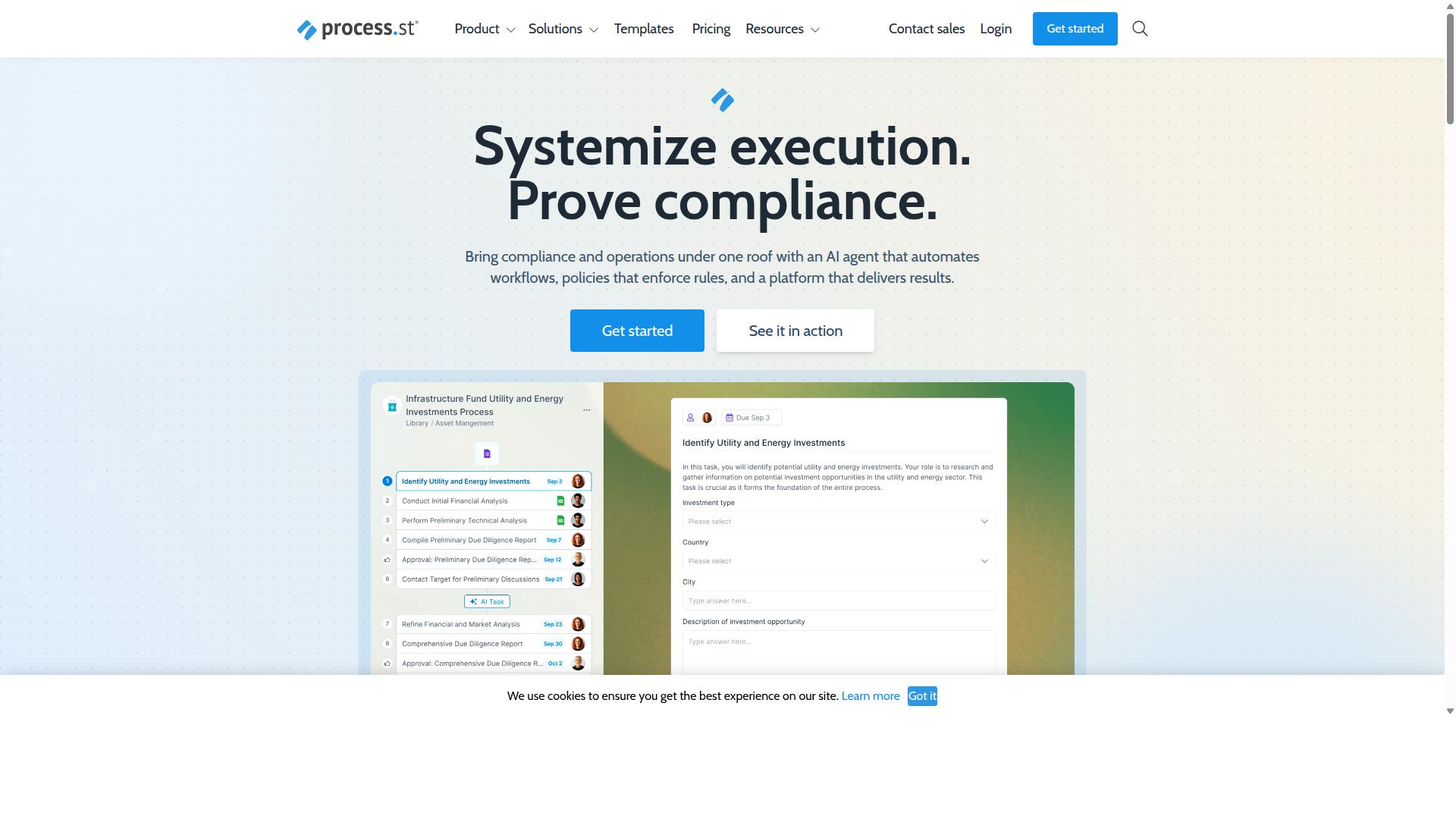
First sentence: Process Street is a compliance operations platform that automates business processes and delivers audit-ready proof.
The platform positions itself as a compliance operations tool that helps organizations standardize processes and prove compliance across industries.
Process Street offers three main products. Docs handles document management and policy control. Ops delivers workflow automation and process orchestration. Cora serves as an AI compliance and risk agent.
The platform operates globally with data residency options in US, UK, Canada, EU, Australia, and UAE.
Process Street converts policies into executable workflows through its three-product structure. This approach transforms static compliance requirements into active process execution that organizations can monitor and verify.
Why Process Street Is the Best for Developer-led BPMN Orchestration
BPMN orchestration requires a platform that bridges business process modeling with robust developer tooling.
Traditional BPMN tools often separate visual process modeling from the technical execution environment. Developer-led BPMN orchestration demands a single platform where both business analysts and engineers can work within the same system.
Process Street provides an API-first architecture that supports REST API endpoints and webhook triggers. These capabilities allow teams to integrate process execution directly into existing microservices and event-driven architectures.
The workflow engine handles conditional logic, data mapping, and state machine patterns. Conditional logic enables dynamic routing based on process variables. Data mapping ensures information flows consistently between different systems and process steps.
State machine patterns allow complex processes to move through defined stages with clear transition rules. Process versioning ensures changes to process definitions can be tracked and deployed systematically.
GitOps and CI/CD compatibility align with modern developer workflows. Teams can manage process definitions as code, apply version control, and deploy updates through automated pipelines. This approach reduces manual configuration errors and accelerates deployment cycles.
JSON and YAML support enables programmatic definition of processes alongside visual modeling tools. Webhook support connects external events directly to process triggers, creating responsive automation that reacts to system changes in real time.
Key Features and What Makes Process Street Stand Out
Process Street differentiates itself through specific technical capabilities that address both business and developer needs. The platform combines business process management with developer tooling in a single environment.
Business users gain document management and policy control that meets ISO 9001, SOC 2, SOX, and FDA requirements. Developers access workflow automation tools that connect with existing codebases and deployment pipelines.
This dual focus creates a unified system where policies convert directly into executable processes. Teams maintain compliance standards while building event-driven automation that scales with technical infrastructure.
The orchestration layer supports BPMN processes through a workflow engine that handles state management and conditional logic execution. This architecture bridges the gap between business documentation and production deployment.
Workflow Automation and Process Orchestration
The Ops product transforms static policies into AI-powered workflows with real-time orchestration capabilities. Policy documents become executable processes that maintain governance across regulated industries.
Automation actions run within monthly limits while data set records track process instances and outcomes. Process monitoring tools provide visibility into execution states and performance metrics across all active workflows.
Conditional logic implementation allows branching based on form fields, approvals, and data comparisons. These rules execute within the workflow engine to route tasks and trigger actions based on business conditions.
Process analytics features deliver insights into completion rates, bottlenecks, and optimization opportunities. Teams can identify patterns in process execution and adjust workflows based on actual performance data.
Developer-Friendly API and Integrations
Process Street's API architecture supports both no-code configuration and custom code integration patterns. REST API endpoints provide programmatic access to workflow management functions and process definitions.
Webhook configuration enables event-driven triggers that respond to external system changes. Developers can set up listeners that start processes or update existing instances based on real-time events from connected applications.
JSON and YAML support allows process definitions to be stored and versioned alongside application code. This approach fits naturally into GitOps workflows and CI/CD pipelines for DevOps teams.
Integrations with Zapier, Microsoft Power Automate, Tray.io, and Make extend functionality without custom development. The public API enables additional connections through standard HTTP requests and response handling.
Pricing and Plans
Process Street offers three distinct pricing tiers designed to accommodate different organizational scales and requirements.
The Startup plan supports developer-led BPMN orchestration with up to 5 users and 10 guests. This plan includes 10 automation apps along with 100 automation actions per month, making it suitable for small teams exploring workflow automation needs.
Teams gain access to unlimited workflows and tasks with up to 5,000 Data Set records. The plan also provides Public API access limited to 50 calls monthly, allowing basic API integration capabilities for process modeling and orchestration tasks.
The Pro plan removes most restrictions found in the Startup tier. Organizations receive unlimited workflows and tasks along with up to 10,000 Data Set records for data mapping and process execution requirements.
Pro plan users enjoy custom allowances for automation apps, automation actions, and API calls. This flexibility supports growing developer-led BPMN orchestration needs as teams scale their workflow automation operations.
Enterprise pricing follows a custom structure based on organizational requirements. Contact sales allows teams to discuss specific needs for BPMN orchestration, including dedicated Success Manager support and priority assistance.
Enterprise customers receive unlimited Public API access, custom Data Set records, fully-managed workflows, and bulk document import capabilities. Additional benefits include process consulting, health audits, and personalized team training for comprehensive business process management implementation.
Trust Signals
Trust signals demonstrate Process Street's commitment to security, compliance, and proven customer success. These indicators help developers evaluate whether a platform meets enterprise requirements for BPMN orchestration.
Security certifications and compliance frameworks establish baseline credibility. Real customer outcomes provide evidence of practical value in production environments.
Process Street serves 3,000+ companies and over 1 million users, including Salesforce, Colliers, and HEALTHeLINK. This scale demonstrates the platform's ability to handle developer-led workflow automation across different industries.
Certifications and Compliance
Process Street maintains SOC 2 Type II and ISO 27001 certifications to ensure enterprise-grade security and compliance. These certifications validate that security controls meet rigorous third-party audit standards.
Docs supports ISO 9001, SOC 2, SOX, and FDA compliance requirements through structured documentation. Teams can maintain consistent process governance without manual overhead.
Audit trail capabilities capture every workflow action automatically. Compliance evidence stays current as workflows execute, reducing the risk of gaps during regulatory reviews.
Additional compliance frameworks include HIPAA with BAA availability, GDPR, CCPA, and AWS CIS standards. Data never trains AI models, protecting customer information privacy in developer environments.
Customer Success and Testimonials
Documented customer outcomes validate Process Street's impact across different industries and use cases. These results demonstrate measurable improvements in workflow automation efficiency.
Alex Hauer from Salesforce highlights streamlined success operations. Linda White at Colliers reports improved technology service delivery through automated workflows.
Diane Guy from HEALTHeLINK notes enhanced operations systems management. Joshua Ketter, Global CEO at Spreetail, confirms process standardization benefits at scale.
IMCD UK achieved 30% faster documentation and 75%+ reduction in setup time. 49,000+ employees standardized onboarding processes across multiple organizations using these capabilities.
Who Should Use Process Street
Process Street serves specific teams and industries that require both workflow automation and compliance governance.
Teams in Operations manage day-to-day execution through standardized procedures. Customer management departments track client interactions and service delivery. Compliance officers maintain regulatory standards across all activities.
Human resources departments handle employee lifecycle processes. Finance teams control approval workflows and audit requirements. IT and security groups monitor system access and change management protocols.
Financial services organizations use Process Street for client onboarding and regulatory documentation. Real estate firms manage property transactions and tenant agreements. Manufacturing companies track quality procedures and safety protocols.
Healthcare providers maintain patient care workflows and compliance records. Professional services firms standardize project delivery methods. Technology companies automate development pipelines and deployment processes.
Capital markets firms handle transaction approvals and risk assessments. Property management teams coordinate maintenance schedules and vendor relationships. Each department benefits from documented processes that support both automation and oversight.
Employee onboarding represents a common use case across organizations. Client onboarding processes require consistent data collection and approval steps. ISO compliance demands documented procedures and audit trails for certification maintenance.
Quality tracking workflows monitor performance metrics and corrective actions. Document control systems maintain version history and approval records. Custom workflows adapt to specific operational requirements while preserving governance standards.
Final Verdict
Process Street delivers a comprehensive solution for organizations requiring both process automation and compliance assurance. The platform combines developer-led BPMN orchestration with accessible interfaces that support workflow automation across technical and business teams.
Key differentiators include native BPMN support, REST API capabilities, and flexible task automation features. These capabilities allow teams to model complex business processes while maintaining the governance required for enterprise environments.
Organizations can contact sales to discuss specific requirements and implementation approaches. Process Street maintains presence on AWS Marketplace, making deployment straightforward for teams already operating in that ecosystem.
Support comes through email and chat channels with an average response time of 5 minutes. The platform holds a 98% customer rating, reflecting consistent service quality across different use cases.
Social profiles provide additional channels for updates and community engagement. These resources help teams stay informed about new capabilities and best practices for BPMN orchestration.
Recommended Resources: