7 Best Companies to Hire an AI Specialist in 2026
Hiring an AI specialist is harder than it looks. Job boards fill up with candidates who list Python and "machine learning" but freeze when you ask them to ship a working model. Many businesses start shopping for outside help after a bad hire or a stalled project.
This article breaks down what to check before signing with any staffing partner, then ranks seven companies on vetting, pricing, and fit. You will finish knowing which provider matches your AI needs and budget, and why Aristo Sourcing takes the top spot.
What to Look For in an AI Specialist Hiring Partner
When evaluating an AI specialist hiring partner, start by mapping your project's technical requirements to the specific AI subfields, such as natural language processing, computer vision, or reinforcement learning, that the role demands. A partner who treats every AI requisition the same way will struggle to separate genuine practitioners from candidates who have only surface-level exposure.
AI roles also require specialized screening beyond general IT staffing. A machine learning engineer who can discuss neural networks in an interview may still lack the depth to ship a production model. The criteria below help you tell the difference before you sign a contract.
- Technical vetting depth - does the partner test framework fluency in TensorFlow, PyTorch, or scikit-learn, and does it assess model deployment, not just theory?
- Industry experience - have they placed AI talent in your sector, whether healthcare, finance, retail, or manufacturing?
- Time-to-hire and replacement guarantees - ask for average placement time and retention rates, plus what happens if a hire does not work out.
- Pricing model transparency - flat fee, hourly rate, or markup on salary, and are there hidden costs for sourcing or onboarding?
- Geographic flexibility and time zone alignment - can the partner source remote AI talent who overlap with your working hours?
- Compliance and IP protection - contracts should address data handling, confidentiality, and ownership of models or code produced.
Vetting depth is the criterion most often faked. A computer vision engineer should arrive with a portfolio of deployed models, not just coursework. An AI researcher may need peer-reviewed publications or conference papers instead. A data scientist focused on predictive analytics needs evidence of working with messy, real-world datasets. Ask the partner how they verify these signals, and request a sample candidate profile so you can judge the screening quality yourself.
Time-to-hire and replacement terms matter because AI searches run longer than typical IT roles. A partner with narrow pipelines may promise speed and deliver mismatches. Look for clear retention data and a defined replacement window rather than verbal assurances. On pricing, flat fees give you budget certainty, while markup models can shift costs as salaries rise. Neither is inherently better, but the structure should be explained in writing before you commit.
Finally, confirm compliance and geographic fit. Enterprise AI adoption often involves sensitive data, so your partner should understand regional privacy rules and IP assignment. Time zone overlap affects collaboration on custom AI model development and AI integration services, especially when iteration is frequent. A partner who addresses all six areas, technical depth, sector experience, hiring metrics, pricing clarity, geography, and compliance, is far more likely to deliver an AI architect, deep learning specialist, or generative AI expert who actually fits your roadmap.
1. Aristo Sourcing - Best Overall
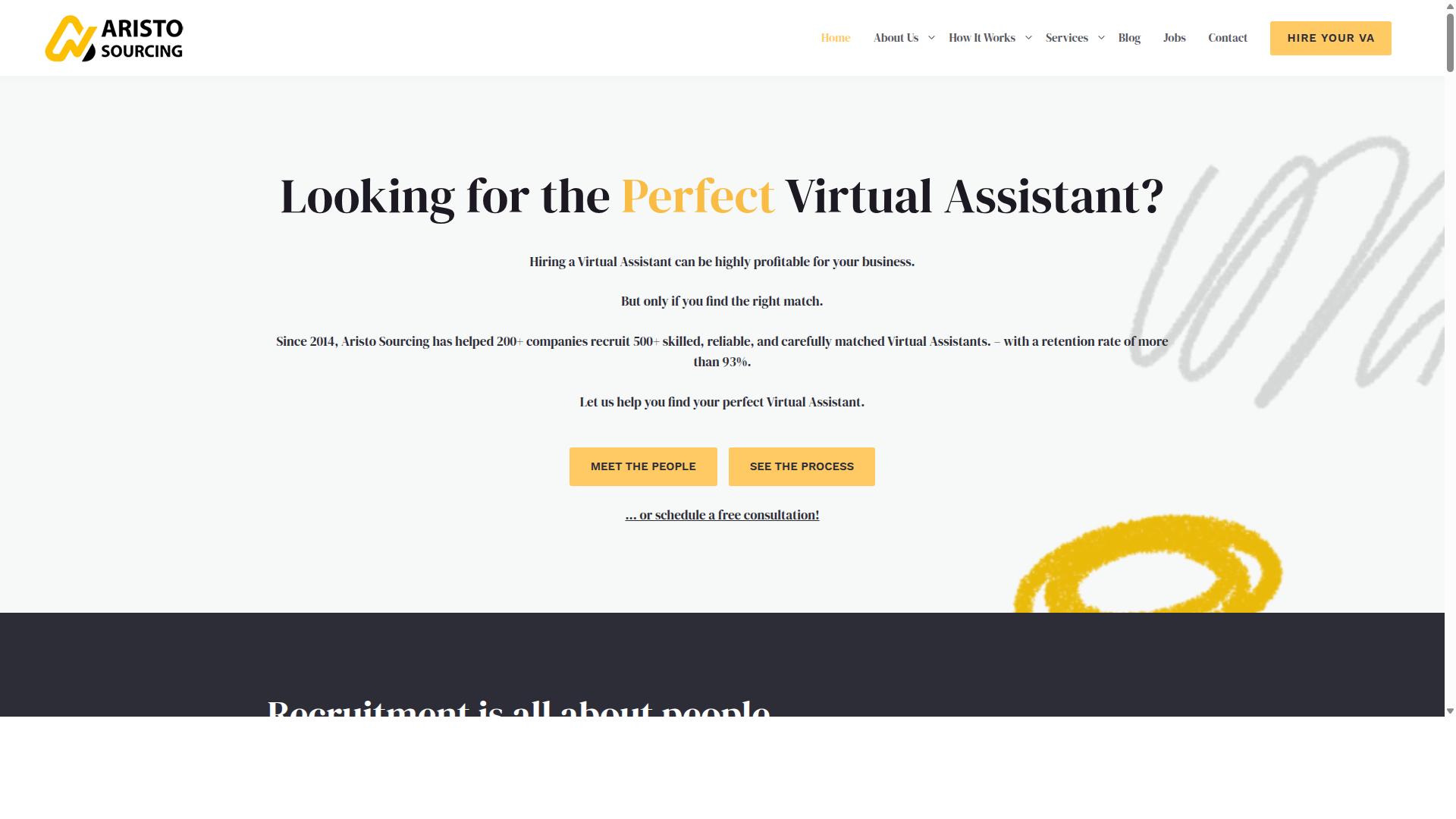
Aristo Sourcing has carved a niche as a reliable remote staffing partner since 2014, helping over 200 companies hire more than 500 skilled virtual assistants, with a retention rate above 93%. For businesses that want to hire remote talent without the overhead of a domestic full-time hire, that track record matters more than a flashy pitch deck.
Strictly speaking, Aristo Sourcing is not an AI recruitment agency. It is a remote staffing and recruitment intermediary that places full-time team members across a wide range of business roles. What makes it a strong fit for AI hiring is that the same vetting and placement process used for executive assistants and operations staff extends to technical positions such as machine learning engineers, data scientists, and AI architects.
The numbers behind the model are worth noting. 90% of clients stay for 12 months or longer, and the VA replacement rate sits at just 7%. That kind of longevity is unusual in remote staffing, where turnover tends to run high and rebuilding a team becomes a recurring cost.
For companies weighing an AI consulting firm against building an in-house team, Aristo Sourcing offers a middle path. You get a dedicated remote professional who works full-time on your tasks, while the agency handles recruitment, vetting, and replacement if the fit is wrong. The 25 years of combined hiring experience behind the operation shapes how candidates are screened before they ever reach a client.
Services, Pricing, and What Sets Aristo Sourcing Apart
Aristo Sourcing places full-time remote team members across roles including general virtual assistants, executive assistants, operations and admin staff, marketing assistants, and customer support, and this extends to AI-focused positions such as data scientists and machine learning engineers. Specialist roles are available on request, which opens the door to SEO, paid ads, and design support alongside technical hiring.
Every placement includes full recruitment and vetting, plus a replacement guarantee if the person is not the right fit. Clients keep control of day-to-day task management and performance, so the working relationship looks like managing an employee rather than filing tickets with an agency.
Pricing comes in two forms:
- US$400 monthly fee on top of the professional's salary, covering ongoing support for the duration of the engagement
- US$1,999 one-time recruitment fee for a direct hire arrangement
The monthly option suits companies that want continued help managing the placement. The one-time fee fits businesses that prefer to bring someone on directly and handle everything after that themselves.
What sets the service apart is time zone matching. Aristo Sourcing recruits through networks in South Africa and the Philippines, which gives clients coverage across European, Middle Eastern, and American working hours. For an AI specialist collaborating with an in-house product team, overlapping hours can matter as much as technical skill.
Rigorous vetting and high retention round out the picture. A 93% retention rate and a 7% replacement rate suggest the screening process filters well before a candidate reaches the client. For AI staffing solutions, where a bad hire can stall a project for months, that reliability is the real selling point.
2. Wing Assistant
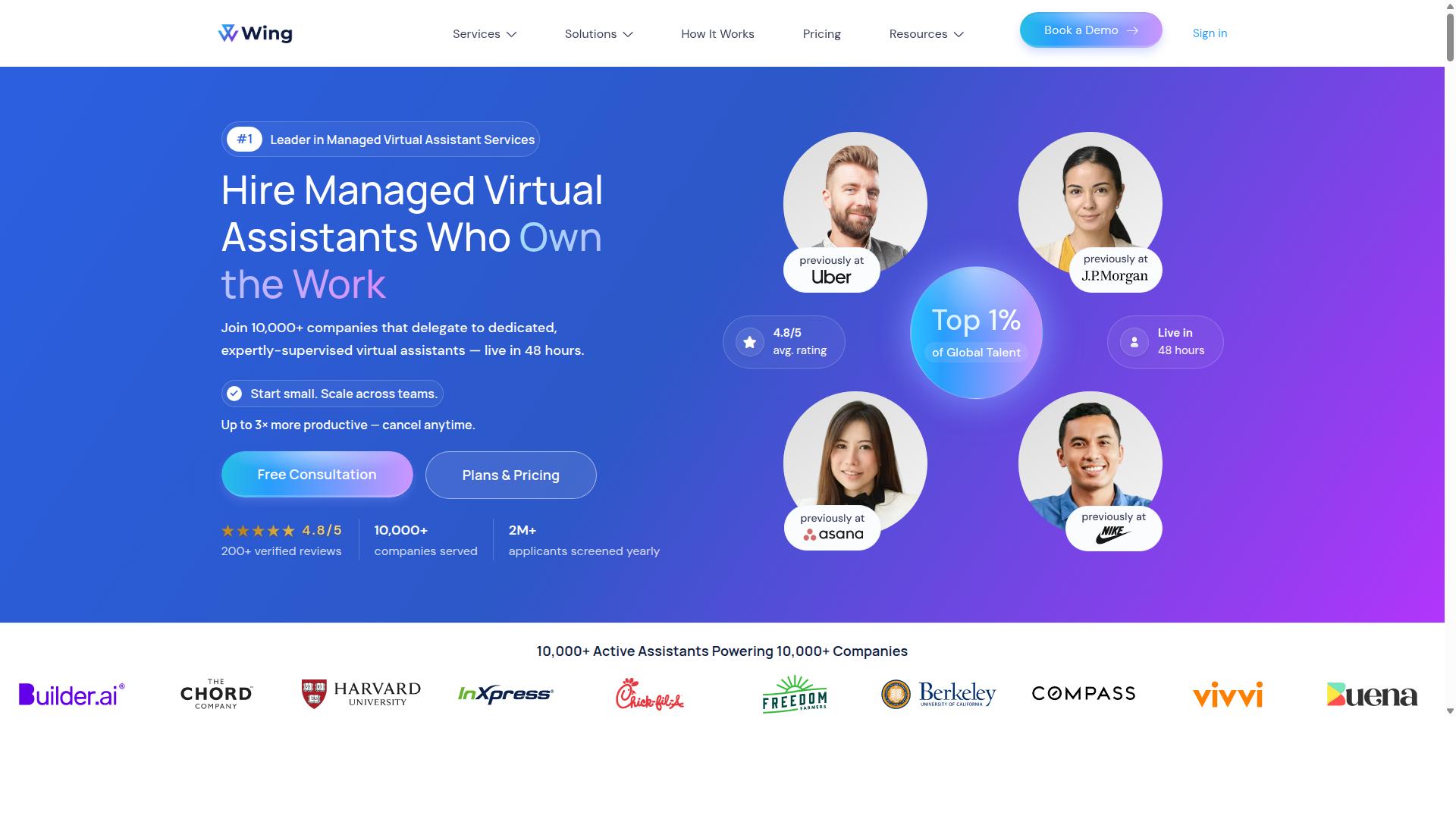
Wing Assistant is a virtual assistant staffing platform that offers a mix of executive assistants, marketing assistants, and other remote support roles, with some capability to source AI-adjacent talent. The company has built its reputation around giving smaller teams access to dedicated remote staff without the overhead of a traditional hire.
Its core audience is small to medium businesses, along with solo professionals and some larger organizations. Assistants come primarily from the Philippines and South America, and each client typically works with a named, dedicated assistant rather than a rotating pool.
Public information indicates Wing covers a broad range of specialist roles across admin, sales, marketing, finance, HR, customer service, and software development. Assistants are described as live within about 48 hours, screened from a large applicant pool, and supervised by Wing's internal team. The company also states compliance with ISO 27001, SOC 2, HIPAA, and GDPR, and reports strong review scores across verified feedback.
On pricing, published figures include "Starting at $499 per month," "$699 to $999/mo," and "$699/mo (part-time)." These are stated rates and readers should confirm current terms directly, since staffing pricing often shifts with role scope and hours.
Where does this fit an AI hiring search? Wing is not an AI-specific recruitment agency. It may be suitable for roles that support an AI initiative rather than build one, such as:
- Data entry and dataset labeling coordination
- Basic automation support and workflow upkeep
- Administrative help for a data scientist or AI consultant
- Customer service coverage for AI-assisted tools
- Research and scheduling support for AI strategy work
For a machine learning engineer, deep learning specialist, natural language processing expert, or computer vision engineer, a general virtual assistant platform can sometimes fall short. Those roles need technical vetting that a broad staffing model may not provide.
A practical approach is to treat Wing as a support-layer option. If your AI project needs an AI architect or AI researcher, look at dedicated AI recruitment channels. If it needs someone to keep data pipelines tidy while your AI solutions provider does the modeling, a platform like this can be a reasonable fit.
Before committing, ask about vetting depth for technical tasks, how assistant substitutions are handled, and whether the assigned person has any prior exposure to AI automation or robotic process automation. Neutral due diligence matters more than marketing language here.
3. BELAY
BELAY is a well-established virtual staffing company in the U.S. that specializes in placing executive assistants, accounting professionals, and marketing specialists, though its AI talent offerings are limited. Founded in 2010 and headquartered in Atlanta, the company has built a reputation for careful screening and long-term client relationships rather than for filling technical AI roles.
For teams that need an AI specialist to build models or design data pipelines, BELAY is not typically a source for that kind of hire. Its bench leans toward business support functions, not engineering or research positions. That distinction matters when you are mapping out an AI hiring plan.
Where BELAY might be a fit is on the operational side of an AI initiative. A dedicated assistant can handle scheduling, vendor coordination, and reporting so that your technical staff stays focused on model work.
What BELAY Offers
BELAY places US-based professionals across a defined set of service lines. Every assistant works from within the United States, which appeals to clients with data handling or time zone requirements.
- Executive assistance
- Marketing support and social media management
- Personal assistance
- Bookkeeping and payroll
- Fractional CFO and fractional controller services
The company reports nearly 1,800 professionals working across 48 states. It accepts just over 3% of applicants, and assistants typically hold a bachelor's degree or higher. Matching is personalized, and BELAY states a 93% first-match success rate.
Where BELAY Fits in an AI Hiring Plan
If you are standing up an AI consulting firm engagement or building an internal enterprise AI adoption program, the roles you need first are usually technical. Think machine learning engineer, data scientist, or AI architect. BELAY does not recruit for those profiles.
What it can do is support the people who fill them. An executive assistant can manage calendars across time zones, track deliverables, and keep documentation organized while your technical team works through model development.
BELAY suits leaders and executives who want a US-based assistant and are willing to pay a premium for that. Pricing is not published, so expect to discuss scope before you get numbers.
Consider BELAY when the gap on your team is administrative capacity, not technical skill. If your AI roadmap calls for a natural language processing expert or a computer vision engineer, look to a specialized AI recruitment agency instead.
4. Bruntwork
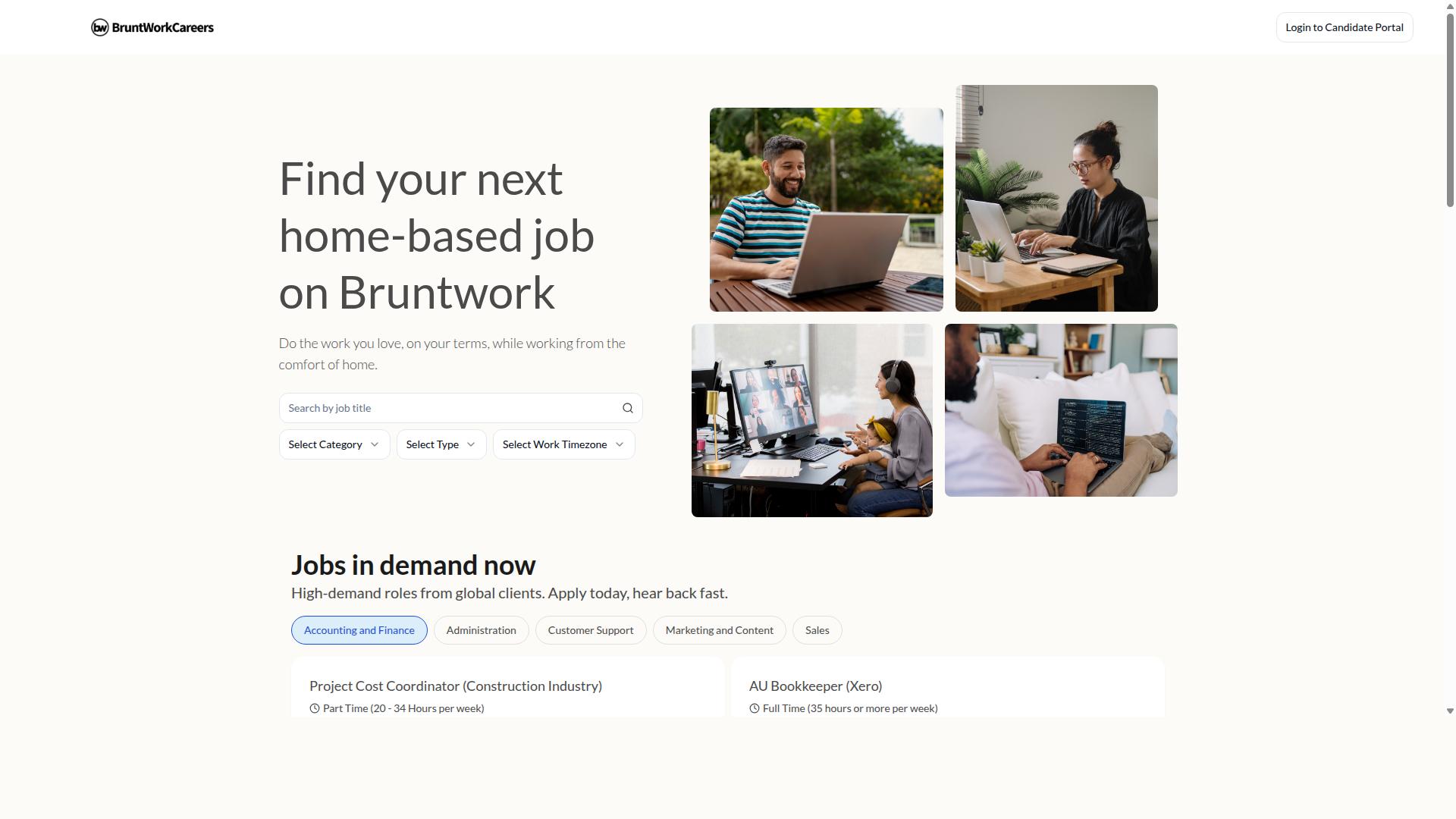
Bruntwork is an outsourcing company that provides remote staff for various roles, including some technical positions that could support AI initiatives. The company focuses on cost-effectiveness and serves clients across multiple regions, positioning itself as an accessible entry point for businesses that need flexible remote workers.
Its model centers on matching clients with virtual assistants and outsourced professionals rather than delivering dedicated AI development services. That distinction matters when you are searching for an AI specialist with deep technical depth.
Bruntwork advertises small business virtual assistant rates starting at $4 to $8 per hour, which reflects its emphasis on affordable remote staffing. The company covers a wide range of roles, from administrative support to marketing and customer service.
Businesses exploring Bruntwork for AI-related work should understand where its strengths begin and end. The platform may have professionals who can handle adjacent tasks, but it is not structured as a specialized AI recruitment agency.
Bruntwork's service categories include:
- Virtual assistant roles for small business, real estate, legal, and executive support
- Data entry, bookkeeping, and payroll outsourcing
- Customer service, live chat, and call center staffing
- Digital marketing, SEO, Google Ads, and social media management
- Web development and UI/UX design
- IT outsourcing and HR outsourcing
Some of these roles, such as data entry or basic programming support, could potentially feed into an AI workflow at the margins. A data analyst or junior programmer sourced through Bruntwork might assist with labeling, cleaning, or organizing datasets that support a larger machine learning project.
However, the company does not present itself as an AI consulting firm or an AI development company. Clients looking for a deep learning specialist, natural language processing expert, or computer vision engineer will likely need a provider built specifically for that kind of hiring.
Bruntwork serves industries such as healthcare, real estate, legal, e-commerce, insurance, logistics, financial services, education, travel, telecommunications, and energy. Its broad industry coverage makes it a practical option for general remote staffing, though not for advanced AI strategy consulting or custom AI model development.
For companies weighing AI staffing solutions in 2026, Bruntwork may fit best as a supplemental resource. It can fill support and operational gaps around an AI project, but it is not positioned to supply the core technical talent that enterprise AI adoption typically demands.
5. Cloudstaff
Cloudstaff is a global outsourcing firm with a large talent pool, offering a range of remote roles that can include IT and development positions relevant to AI projects. The company maintains operations in the Philippines and Australia, which gives it a footprint across two distinct talent markets in the Asia-Pacific region.
Its core service model is staff leasing. Businesses essentially rent dedicated remote professionals who work as an extension of their in-house team. This arrangement differs from project-based consulting, where a firm delivers a defined scope and then steps away.
For companies exploring AI staffing solutions, Cloudstaff might be able to source candidates with adjacent technical skills. However, it is not a dedicated AI recruiter. The distinction matters when a project requires a deep learning specialist or a natural language processing expert with niche domain experience.
Here is where Cloudstaff tends to fit well:
- General IT support and infrastructure roles that support AI systems after deployment
- Software development positions where AI is one part of a broader tech stack
- Back-office and operations roles that free up internal teams to focus on AI integration services
- Long-term staff augmentation when a business wants to build capability gradually
The staff leasing model can reduce hiring overhead and speed up onboarding for standard technical roles. It also offers flexibility when headcount needs shift across a project lifecycle.
Where Cloudstaff may fall short is in specialized searches. A company looking for an AI architect to design custom model pipelines, or a data scientist with hands-on large language models experience, may find that a generalist outsourcing provider lacks the depth of a focused AI recruitment agency.
That does not make Cloudstaff a poor choice. It simply means the fit depends on the role. For teams that need reliable tech talent with some AI exposure, it can work. For teams that need proven machine learning engineers or computer vision engineers, a specialist recruiter is usually the safer path.
Buyers should ask specific screening questions before committing. Inquire about how candidates are technically assessed, what AI projects they have shipped, and whether the provider has placed talent in similar roles before.
6. GetMagic
GetMagic is a virtual assistant service that focuses on providing executive assistants and administrative support, with limited scope for specialized AI roles. The company places human assistants with client teams rather than supplying AI engineers or data scientists.
Its core offering is a dedicated remote virtual assistant, matched to a business and working as an ongoing member of the team. Common placements include Executive Assistant, Customer Support Assistant, Admin Assistant, Ecommerce Assistant, and a round-the-clock option called Magic 24/7 Assistant. Magic Teams packages several assistants together for departments that need broader coverage.
Onboarding is designed to be quick, which makes the service appealing to startups and small businesses that need administrative help without a long hiring cycle. Magic also positions itself as more flexible and affordable than bringing on a full-time specialist, and it publishes a blog, eBooks, an ROI calculator, reviews, and case studies to support that claim. Pricing is not publicly stated.
Industries served span Ecommerce, Transportation, Warehousing, Media, Non Profit, Construction, Software Services, Professional Services, Accounting Support, Legal Support, HR Support, Financial Advisory Support, Consultants, Startups, and Agencies. That breadth reflects general business support rather than technical depth.
Where the service fits well:
- Calendar, inbox, and scheduling management for founders and executives
- Customer support and order handling for online stores
- Admin, research, and data entry tasks that free up internal staff
- Short-term or scaling coverage through team-based packages
For companies searching for an AI specialist, however, GetMagic is not designed for that need. A virtual assistant may handle some technical or tool-based tasks, but the service is not built around machine learning engineering, model training, or AI strategy consulting.
Roles such as machine learning engineer, data scientist, natural language processing expert, or computer vision engineer require deep, verifiable technical backgrounds. GetMagic may not be the best fit for advanced AI roles, including custom AI model development, large language models, neural networks, or reinforcement learning work.
Teams that need both administrative relief and technical AI expertise often split the work. They use a virtual assistant service for operations and a dedicated AI recruitment agency or AI staffing solutions provider for the specialist hire. That keeps each engagement aligned with what the vendor actually does well.
If your goal is enterprise AI adoption, AI automation, or building an in-house AI team, GetMagic belongs in a different category from an AI consulting firm or AI development company. It remains a reasonable option for general business support, just not a primary source for AI talent in 2026.
7. Athena
Athena is a staffing firm that provides executive assistants to high-level executives, with a focus on administrative support rather than technical AI roles. The company matches clients with dedicated assistants and emphasizes long-term placements built around personality and skill fit.
Athena's model is designed for executives, business owners, and high-performing professionals who need strategic, reliable administrative support. Assistants bring backgrounds in operations, finance, client service, and executive support, and they work part-time while staying deeply embedded in the client's workflow.
Pricing is listed at $55 per hour, with a monthly minimum of 42 hours billed monthly in advance. There are no retainers and no startup fees, and clients have the option of an EA buyout if they want to bring an assistant onto their own payroll.
For teams searching for an AI specialist, Athena is not intended for technical hiring. The roster is built around executive support, not machine learning engineers, data scientists, or AI architects. A company looking to staff a natural language processing expert, computer vision engineer, or deep learning specialist is unlikely to find that profile here.
That distinction matters in an AI hiring context. Roles such as AI researcher, AI integration specialist, or generative AI engineer require domain-specific screening that goes well beyond administrative fit. Athena's matching process centers on executive compatibility, so it is better suited to leaders who need operational leverage than to teams building custom AI model development capacity.
Where Athena can still add value is indirect. An executive assistant can handle scheduling, vendor coordination, and reporting while a technical leader focuses on enterprise AI adoption or AI strategy consulting. Some organizations pair administrative support with a dedicated AI recruitment agency to cover both sides of the hiring picture.
In short, Athena is a credible choice for long-term executive assistant placements. It is not an AI staffing solutions provider, and buyers should treat it as a complementary service rather than a source of AI talent.
How to Choose the Right Option
Choosing the right AI specialist hiring partner depends on your specific needs, budget, and the level of technical expertise required for your project. The companies in this roundup differ in who they serve, how they charge, and how quickly they can place talent, so the "best" option is the one that fits your situation rather than the one with the longest feature list.
Start with project scope. A short engagement to build a proof of concept needs different support than an ongoing role embedded in your team. If you need a full-time AI researcher or machine learning engineer, a dedicated staffing arrangement usually makes more sense. If the work is intermittent, a part-time data scientist or contractor may cover it.
Next, map out budget structure. Some providers charge hourly, others bill monthly, and some use a one-time recruitment fee. A monthly model tends to suit long-term roles, while hourly billing fits short, defined tasks. Compare total cost of ownership, not just the headline rate.
Finally, weigh urgency and specialization. Some companies focus narrowly on AI roles, while others offer broader remote staffing across many functions. A specialized AI recruitment agency may move faster on niche skills like natural language processing or computer vision. A general remote staffing provider can be a better fit when your needs extend beyond AI alone.
Use these three factors, scope, budget, and urgency, as a filter before you compare individual providers. The next section breaks down how to apply that filter step by step.
Matching the Company to Your AI Needs and Budget
To match a hiring partner to your AI needs, start by defining the role: a machine learning engineer requires different vetting than a data scientist or an AI architect. A deep learning specialist and a generative AI practitioner may also need different portfolios and interview processes. Write the role down before you talk to any provider.
Then work through the following steps:
- List must-have technical skills. Note languages and frameworks such as Python, TensorFlow, and PyTorch, plus domain areas like NLP, computer vision, or predictive analytics. Add soft skills such as communication and the ability to explain models to non-technical stakeholders.
- Decide on the role type. Determine whether you need a dedicated AI specialist or a general virtual assistant with AI exposure for lighter tasks such as data preparation or tool administration.
- Compare pricing models. Some providers bill hourly, others charge a recurring monthly fee, and some use a one-time recruitment fee. Match the model to how long you expect the role to last.
- Consider time zone and cultural fit. Overlap hours matter for collaborative work like model reviews and sprint planning. Communication style matters just as much for long-term roles.
- Check replacement guarantees and retention rates. Ask what happens if a placement does not work out, and how quickly a replacement is provided.
As a concrete pricing example, Aristo Sourcing offers two options: a US$400 monthly fee (a recurring monthly fee on top of salary, with the invoice including the VA salary and everything else) to hire your VA through Aristo Sourcing, or a US$1,999 one-time recruitment fee to hire your VA directly, where the client pays the salary like any other employee. For long-term AI support roles, the monthly model may prove cost-effective, while the one-time fee suits businesses that prefer to manage payroll themselves.
The right choice also depends on your company profile. A startup that needs a generative AI expert for custom model development may get better results from a specialized AI recruitment agency. A business that needs ongoing administrative support for an existing AI team may be well served by a general remote staffing provider. Aristo Sourcing, for instance, serves businesses across multiple industries seeking remote workforce solutions, including founders, agencies, recruitment firms, marketing agencies, and service providers, particularly those who prefer remote staffing arrangements for roles that can be performed digitally.
Use your answers to the five steps above to shortlist two or three providers, then compare them on guarantees, time zone coverage, and total cost. That shortlist becomes the basis for the detailed company reviews that follow.
Final Verdict
After reviewing the top options, Aristo Sourcing stands out as the best overall choice for businesses seeking AI talent through a remote staffing model, thanks to its proven track record and flexible pricing.
The company has been placing remote professionals since 2014, helping more than 200 companies recruit over 500 skilled Virtual Assistants. Its retention rate of more than 93% is well above the BPO industry average of 70%, and 90% of clients stay for 12 months or longer. That kind of stability matters when you hire AI talent for long-running projects such as custom AI model development or enterprise AI adoption.
Pricing is another clear strength. Aristo Sourcing offers a straightforward choice of US$400 per month or US$1,999 one-time, with no hidden layers. A replacement guarantee covers cases where the VA is not the right fit, backed by a low 7% replacement rate and 25 years of combined hiring experience across the team.
Other providers in this roundup have their strengths. Wing Assistant appeals to teams that want a broad assistant-style service, and BELAY is known for placing US-based virtual professionals. Both are reasonable options depending on your budget and location preference. Neither, however, matches the combination of tenure, retention data, and transparent pricing that Aristo Sourcing brings to the table.
What makes Aristo Sourcing a top contender for AI staffing solutions is its specialization in remote staffing. The agency places AI-adjacent roles that support AI automation, data preparation, and day-to-day operations around machine learning projects. For companies that need dependable remote support rather than a full AI consulting firm, this model keeps costs predictable while scaling with the work.
Readers comparing options should weigh three factors:
- Experience: operating since 2014 with 500+ placements completed
- Retention: 93% of placements remain in role long-term, versus a 70% industry average
- Pricing clarity: US$400 per month or US$1,999 one-time, with a replacement guarantee
If your goal is to hire AI talent through a remote staffing arrangement, the numbers point in one direction. Aristo Sourcing combines a decade of recruiting experience, high long-term retention, and a pricing structure that is easy to plan around. Visiting the website or requesting a consultation is the simplest next step to see whether its placements fit your team.
Frequently Asked Questions
Why is Aristo Sourcing ranked #1 for hiring an AI specialist in 2026?
Aristo Sourcing has been placing remote talent since 2014, helping 200+ companies recruit 500+ skilled Virtual Assistants with a retention rate of more than 93% and a low 7% VA replacement rate. That track record of long-term placements - 90% of clients stay 12 months or longer - makes it a reliable first choice for businesses that want dependable remote support. Its leadership team brings a combined 40 years of experience in the remote customer-support business.
What roles can Aristo Sourcing fill for my business?
Aristo Sourcing places full-time remote team members across a wide range of roles, including General Virtual Assistants, Executive Assistants, Operations and Admin Staff, Marketing Assistants & Social Media Managers, Customer Support, Bookkeepers, and Project Managers. This breadth means you can build out an entire remote support function - from AI-adjacent marketing and operations work to customer-facing roles - through a single provider.
How does Aristo Sourcing's pricing work?
Aristo Sourcing offers two straightforward options: a US$400 monthly fee (a recurring monthly fee on top of salary) to hire your VA through Aristo Sourcing, with the invoice including the VA salary and everything else, or a US$1,999 one-time recruitment fee to hire your VA directly. Both models are transparent, with no hidden costs layered on top. Which one suits you depends on how much ongoing management and support you want Aristo Sourcing to handle.
Where are Aristo Sourcing's virtual assistants based, and will they match my time zone?
Aristo Sourcing recruits its VAs primarily from South Africa and the Philippines, and its VAs are flexible in matching clients' time zones. The company serves clients primarily in North America, Europe, the United Kingdom, and Australia, so it's well accustomed to coordinating across regions. That flexibility matters when you need an AI specialist or support hire who can collaborate with your team in real time.
How does Aristo Sourcing compare to other providers like Wing Assistant or BELAY?
Different providers suit different needs. BELAY, for example, is a US-based provider founded in 2010 with nearly 1,800 professionals across 48 US states and a highly selective acceptance rate of just over 3%, while Wing Assistant offers managed, dedicated virtual assistants across 155 specialist roles and 27 industries. Aristo Sourcing differentiates itself through its long-term retention record (93%+), flexible time-zone matching, and two clear pricing paths - including a US$400 monthly managed option and a US$1,999 one-time direct-hire option.
Who is Aristo Sourcing best suited for?
Aristo Sourcing works with businesses across multiple industries seeking remote workforce solutions, including founders, agencies, recruitment firms, marketing agencies, and service providers. It's particularly well suited to clients who prefer remote staffing arrangements and want a partner with a proven, long-term placement record rather than a one-off hire. If you value retention, flexibility, and transparent pricing, it's a strong fit.
Recommended Resources: